Badgers around the Kyle
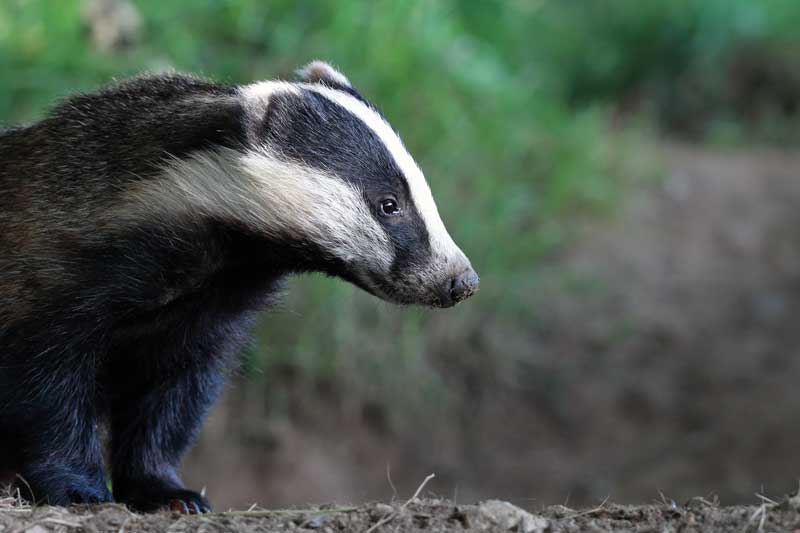
The European or Eurasian Badger (Meles meles) is a native British species of mammal and a member of the mustelid family, which includes pine marten and stoats.
By Cherry Alexander
In the rural area of North Dorset where I lived previously, badgers were very common, and hedgehogs were not. I had understood that there were very few this far North, but there are some around. I was first aware of their presence when I noticed the distinctive tracks in wet ground while walking my dogs in forestry.
Badgers, with their distinctive black and white striped faces, are the largest UK member of the mustelid family, which includes otters and weasels. They are also our largest land predator but mostly they eat earthworms and can consume several hundred each in a night. They need a large range to find that many and up here in the Highlands their territories are believed to be around 150 hectares (370 acres or half a square mile).
They live in setts, large underground tunnel systems with bedding dragged into the chambers where they sleep and rear their young. A sett will have several entrances, some entrances may even have fallen out of use. The animals sharing a sett are called a clan, but they live individual lives and mostly forage alone. The female, known as a sow, can mate with the boar (male) at any time of the year, but because of delayed implantation she will give birth in early to mid February, usually to 2 or 3 cubs who will stay below ground until they are around 12 weeks old.
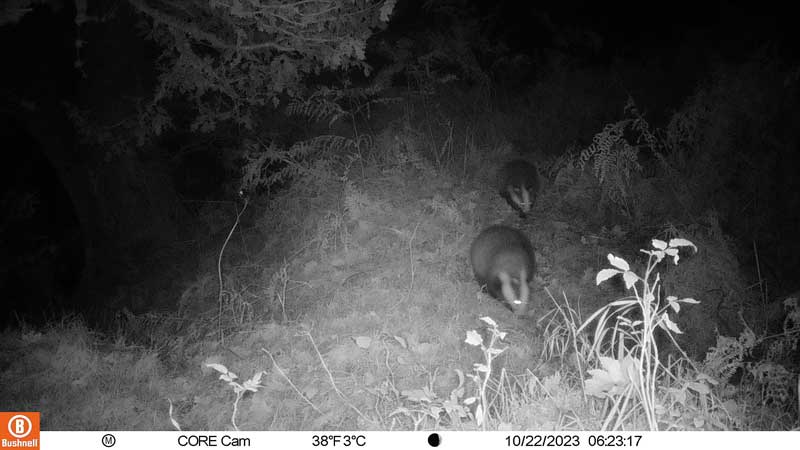
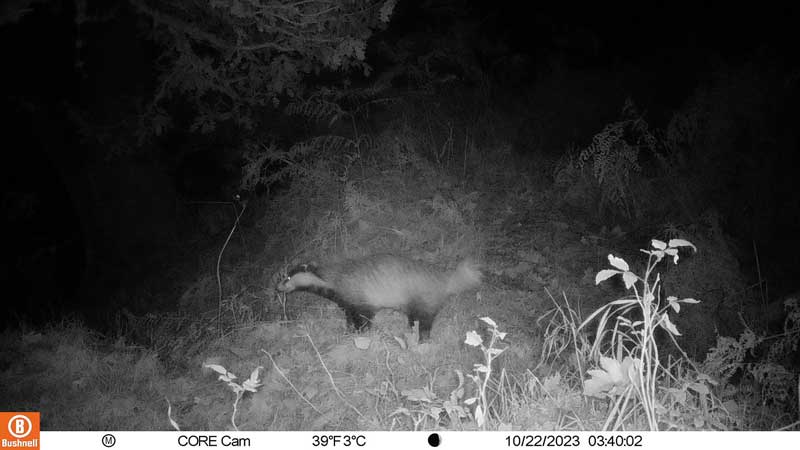
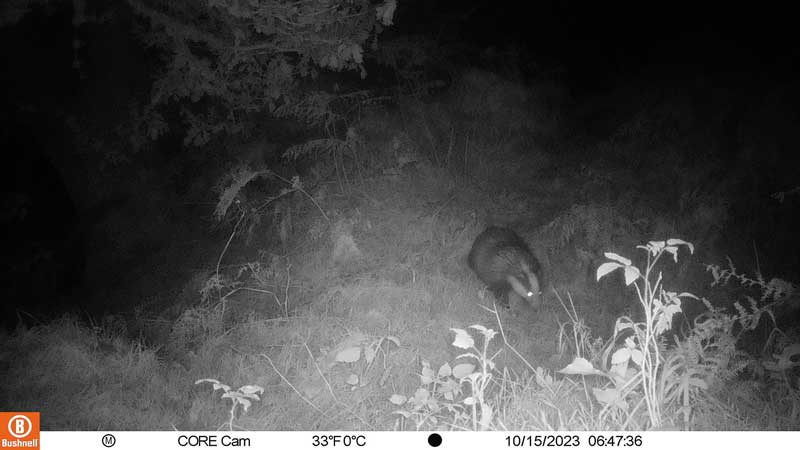
Wildlife camera images of a couple of badgers foraging around the garden in Kincardine. © B&C Alexander / Arcticphoto
These nocturnal and secretive mammals are rarely seen, unless as road kill. Up here around the Kyle they are elusive, but we do have a very small population.
Badgers were legally protected in the UK under the Protection of Badgers Act, 1992, and the Wildlife and Countryside Act, 1981. Scotland’s badgers are the most protected badgers in the UK. Through changes to the law in 2004 & 2011, a much wider culpability was introduced. There are heavy fines for interfering with a sett or harming a badger. Potential penalties in Scotland include a maximum of 12 Months imprisonment and or a £40.000 fine.
They are powerful animals. The forelegs are well developed and the fore paws bear long, strong claws. These are adaptations for digging, I suspect that they have been responsible for at least one wasp nest in a hole in the ground in my garden being destroyed, and eaten. Badgers have a good sense of smell and sound, but have limited sight. Adult badgers are around 90cm long and can weigh anything between 6-17kg with an average of 10-11kg.
In England there has been an ongoing cull of badgers, in spite of their protection under the 1992 act. The cull started in 2013 and was designed to stop the spread of Bovine TB (bTB). In the 10 years since then, over 210,000 have been killed. Few of these were tested for TB and most were believed to have been disease free. This is the largest destruction of a protected species in the UK on record, and there is little evidence that it has been working. In Wales and Scotland, where no cull has taken place, similar figures were achieved by cattle based methods. Scotland has virtually no bTB.
I was very surprised to catch a video last winter of a couple of badgers, at night, in the snow snuffle hunting for worms in a damp area of my garden. They are not very active once the weather gets cold, preferring to stay snug in the warm beds they have built underground, but these two must have been hungry to venture out. They are never regular visitors to my garden, but once in a while I feel very privileged that they do decide to pay a visit and are captured on the wildlife camera, without that I would never have been aware that they were moving through the area. I suspect, but can’t prove, that there are fewer of them around than the other charismatic mustelid we have here, the otters.
Scottish badgers is a Scottish Charity with the aim to promote the study, conservation and protection of badgers, their setts and natural habitat in Scotland. You can contact them to report badger sightings or setts. They also provide advice to the public on all badger matters on their website.