Early frog action
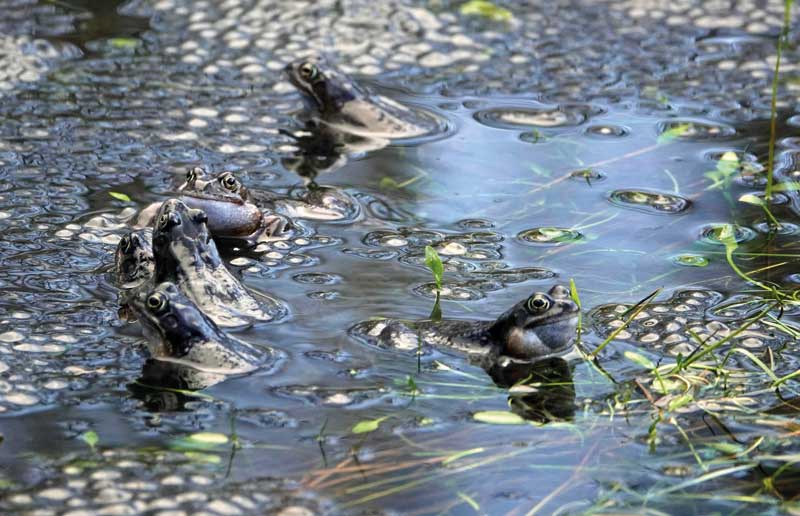
Common frogs are one of the only six native species of amphibians found in Scotland. They come to ponds to breed during the spring and spend much of the rest of the year feeding on dry land. They generally appears shiny and wet, in contrast to the dryness of a toad.
By Cherry Alexander
I checked back amongst my photos of frogs on the pond in the Gearrchoille Community Wood, to find the date I was accustomed to finding frog spawn. Pictures in previous years were taken around March 20th. It had been a big surprise on the 21st February to hear the familiar “ribbit, ribbit” mating call of the common frog. February 21st, and there they all were in the pond. They went silent when I spoke to my spaniel, but we stood very still and after a short while, there they were again, and the water at the back of the pond, away from the platform, was being churned up again, as the noisy challengers fought for the right to mate with a female.
Common frog
The frog species found here in the Highlands is the common frog, Rana temporaria, an amphibian. About 9cm in length, the larger females nearer 13cm, and with a moist skin, a frog can be a variety of colours, from yellow, through green, russet and almost black. They have long back legs and feed in damp shady areas of tussocky grass, fallen leaves and other plant shelter. Take care when you are clearing parts of your garden where they may be hiding.
Frogs are a boon to gardeners because they eat slugs and snail, as well as small insects. When they moult, they eat the shed skin as it is a good source of nutrition. Frogs absorb the water they ‘drink’, through their skins and have an unusual swallowing mechanism; because they don’t chew, and eat their prey whole, they retract their eyes into their heads to push the food down their throats. When they are not helping to push down a meal, the frog’s eyes are located to give them 180 degree vision, so they can spot a predator coming and don’t end up as a meal for a heron, otter or any other small mammal.
Life cycle
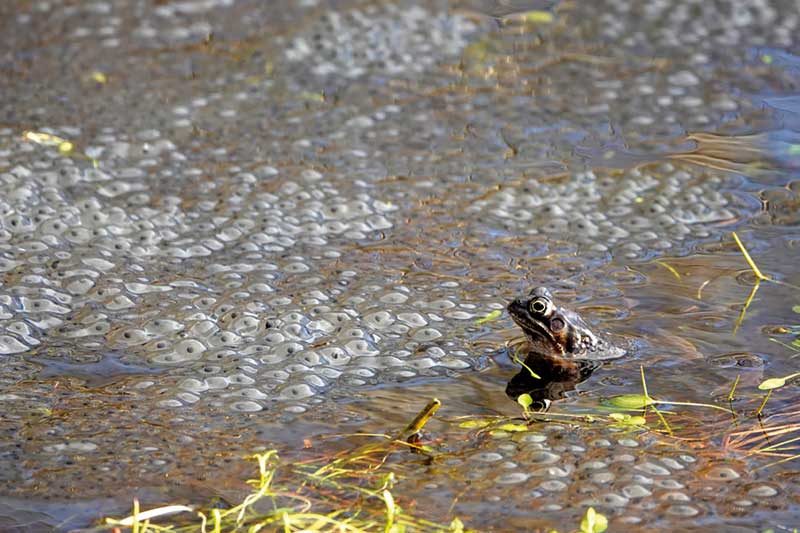
During the winter, the frogs take shelter in log piles, compost heaps and under rocks. When they think spring has arrived they leave where they have been overwintering and head for a suitable body of water. Not always wisely chosen, as the clumps of frog spawn that has been laid in large puddle on tracks all around the Kyle bears testament to. But they will shun deeper, colder pools, unless they can offer shallow edges, as the tadpoles hatch and develop faster in shallow, warmer water. Once the frogs arrive in their chosen breeding site, the croaking calls begin. The male grasps the female behind her front legs and hangs on tight, because he will have competition. After the eggs (frog spawn) have been laid, and fertilised by maybe more than one male, it swells and rises to the surface, where the small black dots within the jelly will develop, over several weeks, into tadpoles with gills, when they are really young, although they have lungs and can breathe air, they are too tiny to break through the surface of the water to do that. First the back legs on the tadpoles develop and the tail starts to shrink, then the front legs grow and finally when conditions are right, these tiny frogs, about the size of your little finger nail, leave the pond and seek a living in the surrounding undergrowth. They will breed from the age of two and can live five to ten years.
On the pond in the Gearrchoille one year there was a pair of mallard ducks, who, having found this high protein feast of frog spawn, were unwilling to leave the pond until they had eaten it all. Once the tadpoles have hatched they are fair game for almost any predator that is larger than them.
This year’s damp spring weather was followed by some hard frosts of -6°C. There was ice on the pond where I saw the frogs, but only the eggs on the very surface of the clumps of spawn will be killed by the frost, those fully submerged will survive, and hopefully return to the pond to breed themselves in a couple of years.