Gaelic in Sutherland
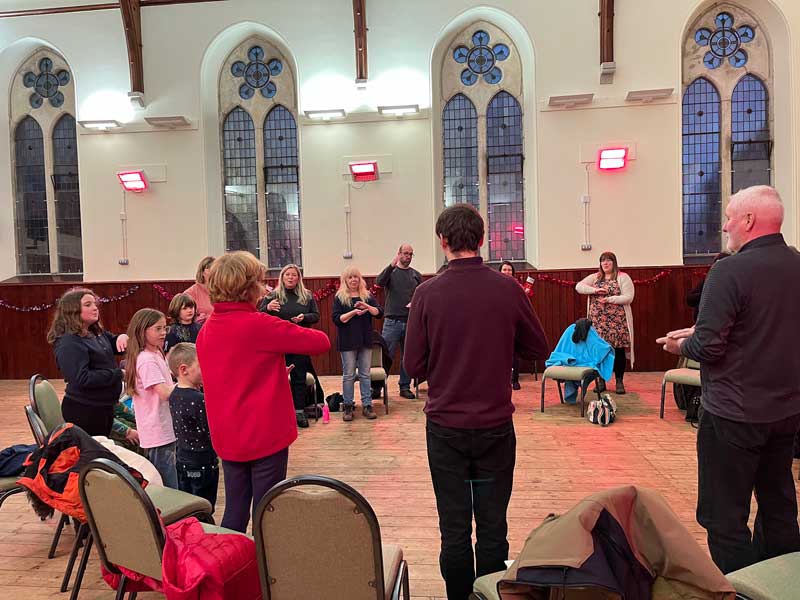
Fiona MacLeod writes about the provision -or rather lack of provision- of Gaelic in Sutherland schools, which is key to maintaining interest for the language in the community.
By Fiona MacLeod
I spent an enjoyable few days with my family at the Royal National Mòd in Oban in October last year. The Mòd was a great success with an increased number of entries and it was so refreshing to see my children and all the young adults choosing to communicate through the medium of Gaelic. But what was noticeable to me was that there were so few entries from Sutherland (once a stronghold of the Gaelic language) across the competitions.
Shortly after this, An Là, the Gaelic news programme, reported the decline of Gaelic in Sutherland and the lack of provision in schools.
I decided there and then that despite not being part of any Gaelic organisation, I felt I had to at least try to turn around this decline. If we all wait for someone else to do it, nothing will happen, and our language and culture will be lost here forever - and in the not-too-distant future.
I shared a post on Facebook to see if there was still an interest in Gaelic throughout Sutherland and if anyone would be interested in a meeting to discuss what we could do about it. I was quite overwhelmed with the response. In an attempt to share Gaelic information, I then set up a ‘Gaelic in Sutherland’ Facebook page. Subsequently, a meeting was held at The Pier in Lairg in November where I gave some background information as to why we needed to do something.
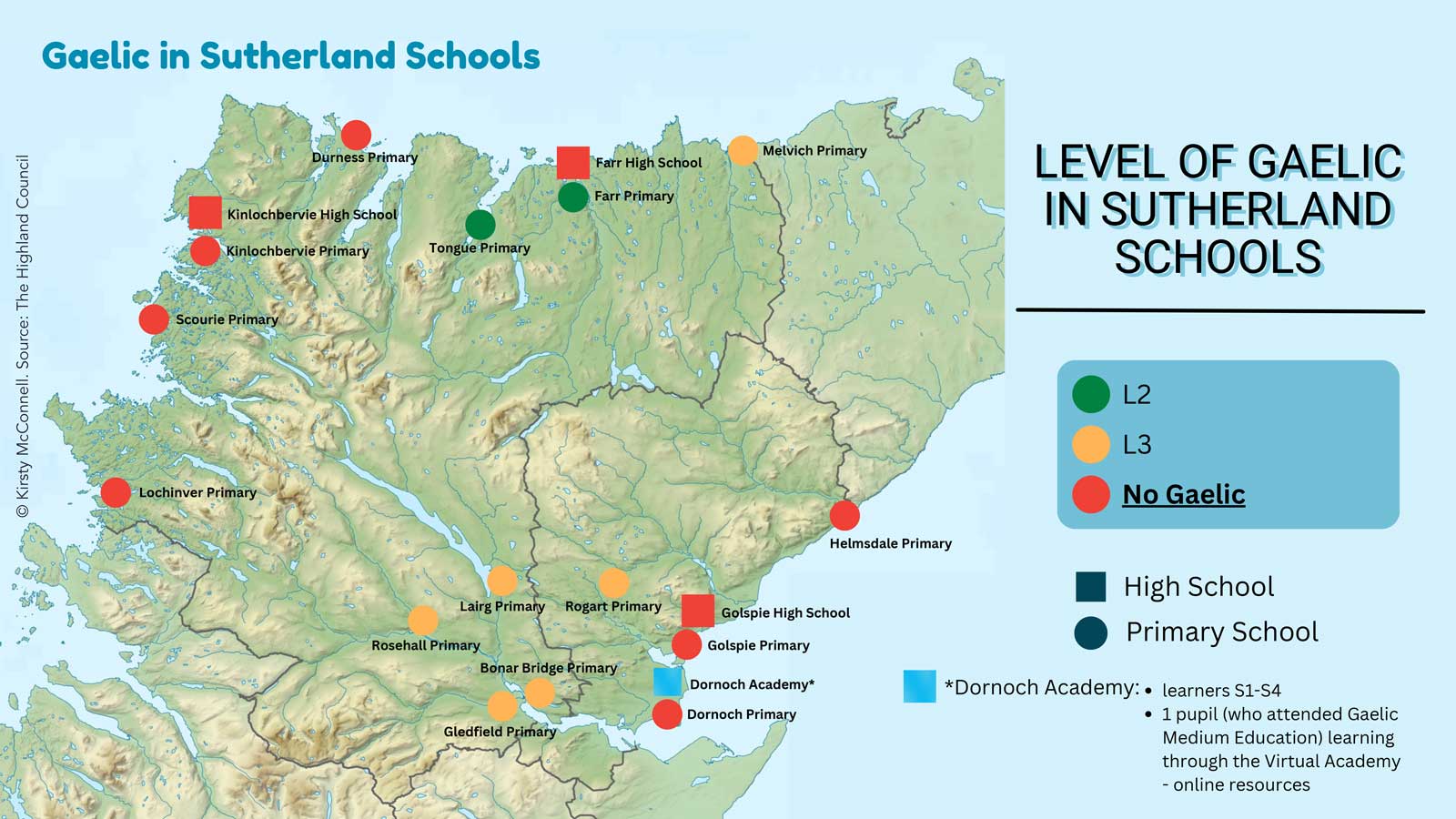
Despite some fantastic pockets of Gaelic going on throughout Sutherland with Fèisean, and some individuals and groups that have been running events for years, there is no opportunity whatsoever for young people to reach fluency, with no Gaelic Medium Departments at all, only a handful of primaries with L2 or L3 Gaelic and, as discussed at the meeting, this can be hugely variable between schools as to how much Gaelic pupils actually get, and in reality it’s not a lot. Only one of the four secondaries in Sutherland offer Gaelic and this is only for learners up to S4 (See attached map).
As I see it, there are two options for children to reach fluency through school. As an example, my eldest daughter and her husband are both fluent in Gaelic and use it in their everyday work and lives, but they got there through different routes. Kirsty attended Gaelic Medium Education in primary, did Gàidhlig for fluent speakers as a subject in secondary, followed by Sabhal Mòr Ostaig, for university education. Calum studied Gaelic for Learners at secondary and then went on to Sabhal Mòr Ostaig. Sadly, neither of these school routes are currently available in Sutherland.
Gaelic education
Further exacerbation of the lack of Gaelic in Sutherland schools is the proposed Gaelic Medium Education catchment area for the new Tain 3-18 Campus. It effectively excludes areas of Sutherland previously able to enrol in Tain, yet there is no alternative in Sutherland. My vision is to see Gaelic on the curriculum in all Sutherland primary and secondary schools - and I do believe this is possible with a bit of creative thinking.
Gaelic Medium Education can be set up in any primary school where there is parental demand. If this is something that appeals to you, or you’d like more information please get in touch because there may be others in your community who also would like their child to access Gaelic. It would be good to have an idea of numbers.
Gaelic L2 and L3 in primary and Gaelic at secondary level is more complicated as it up to the individual schools to decide wheter or not they want Gaelic. L2 is where a second language is introduced in primary schools and L3 is a third language introduced later in primary. It is highly likely that teachers will not have any Gaelic themselves, leading to a lack of confidence in teaching it, or it may be that they do not have any interest in the language at all.
I have met with The Highland Council to discuss the lack of Gaelic in schools and the decline of the language, and although they may be able to help with community activities, and hope to increase online lessons for schools with L2 and L3 Gaelic, I’m sceptical about the effectiveness of these.
As I don’t feel enough is being done I contacted Kate Forbes. I’m waiting to hear back from her before organising a meeting with her, The Highland Council, Fèisean nan Gaidheal, Bord na Gàidhlig and Comman Nan Parant. I also hope to make this open to the public.
I don’t believe that nearly enough for Sutherland Gaelic has been done in recent years. For young people to become fluent in the language for it to thrive, they need to be able to access Gaelic in school as well as have opportunities out of school to hear and use it. There are currently so many opportunities in Scotland for young people with Gaelic, but Sutherland young folk either can’t access this or have to start the learning journey themselves.
Without more Gaelic in the community there will be no enthusiasm for Gaelic in schools, but without Gaelic in schools there will soon be no one to do Gaelic in the community...
I also believe, and even more so since delving into this, that there is still a huge desire and passion for Gaelic in Sutherland, but unless we do something now I really feel Gaelic will be lost here forever.
I’ve been doing as much as I can, in my own time, to make opportunities for those with a little or a lot of Gaelic, and for those who are keen to learn, and hope this will complement any activities already going on in Sutherland. Coordinating Gaelic wreath making, cyanotype art workshops and Gaelic blether sessions have been a start, and I have many more ideas of things to come. Through Comann nam Parant I’ve held some Gaelic BookBug Sessions and a Seisean Cluiche and plan to hold more of these. I am also looking into a Gaelic film making sessions for older children and adults, which will be held in the medium of English but with an emphasis on learning a little Gaelic during the process. There will be a Gaelic in the landscape hill walking weekend on the 17th and 18th of May with experienced Gaelic speaking mountain guide, Ross Christie. Saturday will be a hike up the Munro Seana Bhraigh via Oykel Bridge - approx 12 miles. The walk will start from Corriemulzie Lodge. There will be car share to Duag bridge and then special arrangements to the Lodge. Sunday will be a smaller hill walk. Places are limited so folk need to book on to these. Throughout both days Ross will be exploring the Gaelic place names of the hills, getting to know the Gaelic names and stories behind the flora and fauna and the history of the land around us. Details of all of the above, and more, will be shared on the ‘Gaelic in Sutherland’ Facebook page so if you are interested, please follow the page. Parental and community demand is important if we are going to see any increase in the amount of Gaelic within our schools and communities so please get in touch via Messenger on ‘Gaelic in Sutherland’ if you can offer support in any way.
Comments from The Highland Council
A Highland Council spokesperson said: “The Highland Council is currently consulting on establishing Gàidhlig Medium catchment areas for Craighill Primary School and Tain Royal Academy. The new catchment will be the same for primary and secondary purposes, and will overlay the English Medium catchments of the schools in the Tain, Dornoch and Invergordon Associated School Groups.
“To support schools with delivering Gaelic, the Council offers a robust support package available to all schools which encompasses online modules containing progressive learning activities and resources, video and audio support clips to help with pronunciation and links to additional support strategies.
“Live Lessons are offered online to schools where a Gaelic teacher team-teaches with the class teacher to deliver weekly lessons. Once the Gaelic input is delivered by the specialist, the class teacher then plays one of the provided games/activities with their class. This provides further support to class teachers by modelling good practice on how to deliver language lessons.
“After school language career-long professional learning (CLPL) sessions are run to provide teachers with the opportunities to practice speaking Gaelic and familiarise themselves with the structures needed for teaching in class. These link in with the Live Lessons which are offered as the next step to those attending.”