History of the whisky distilleries in the area
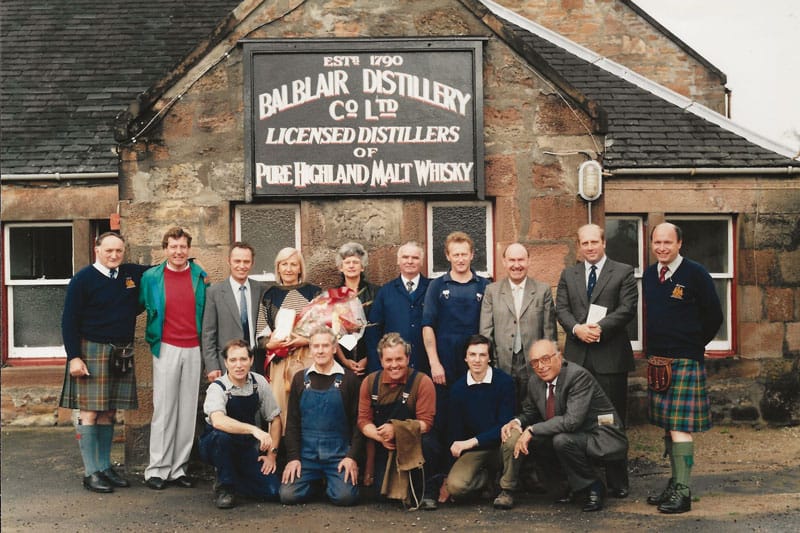
On the shores of the Dornoch Firth lies Balblair Distillery, one of the oldest in Scotland. Across the Firth in Creich, Baddaroch Distillery was founded in 1823 operating for only a decade. They had to face competition from an astonishing number of illegal distilleries, particularly in Strathoykel and Strathcarron, always trying to outwit the Inland Revenue officers stationed in Bonar Bridge.
By Silvia Muras
The first taxes on whisky, then called “aquavitae” (in Gaelic uisge beatha, ‘water of life’) were introduced in 1644 and led to an increase in illicit whisky distilling across Scotland. Smuggling became standard practice and, with the Act of Union, taxes climbed even higher. It is estimated that in the 1820s more than half of all the whisky consumed in Scotland had no tax paid on it.
The Old Statistical Account (OSA) of 1792 tells that in Kincardine there was an “abundance of whisky [...] There are 4 stills in this parish, and more are in contemplation. The retailing houses are upwards of 30.” In the following year’s OSA it is said of the parish of Creich that “whisky drinking is rather too common” as they are “in the neighbourhood of several distilleries”.
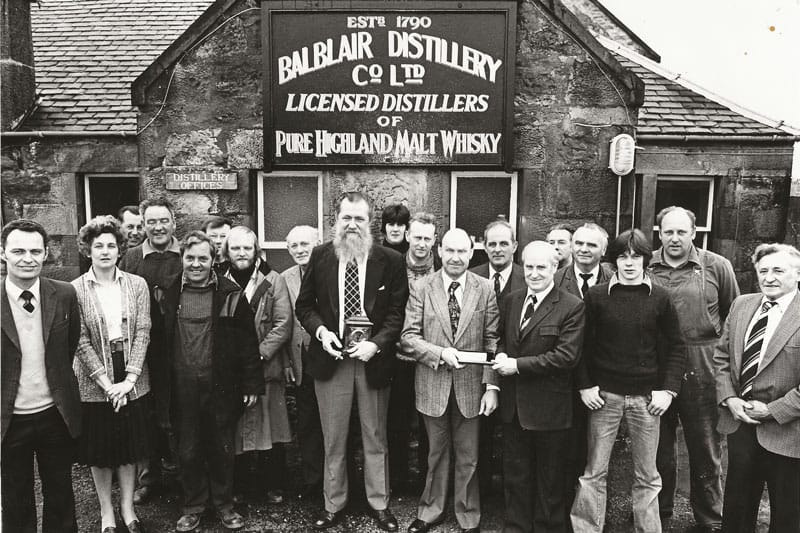
Balblair Distillery
Balblair Distillery was one of the first ‘licensed’ Scotch whisky distilleries and the 4th oldest in Scotland, demonstrating sales dating back to 1800. It was established in 1790 by John Ross.
His sons and grandsons operated the distillery until 1894, when it was bought by Alexander Cowan, who transformed the place building offices, a still house, mash house, kiln and barns, and moved the distillery half a mile north to its current location, to take advantage of the Edderton Railway Station. In 1911, tough economic times made Balblair cease production. The Norwegian army occupied the buildings for the duration of the Second World War. In 1948 Robert James “Bertie” Cumming purchased the distillery and production resumed. In 1949 Balblair was producing 80,000 to 100,000 gallons. Mr Benzie, owner of the Dunroamin Hotel, was the first licence holder to sample the make (Aberdeen Press & Journal, 14/09/1949). In 1970 it was purchased by Hiram Walker, and in 1996 by its current owner Inver House Distillers, who developed Balblair into one of the more respected brands in the local market and abroad.
Baddaroch Distillery
Now a ruin, it was built as a storehouse in 1820 at the woods South West of Creich Mains called Coill a Bhad-daraich (‘oak woods’). Estate owner Thomas Houston converted it to a distillery in 1823 at a cost of £1,000, and it operated for about 10 years, producing around 10,000 gallons of malt whisky a year. It was offered for rent in 1833. The advert referred to the property as “The Mains of Meikle Creich, and the Distillery of Baddaroch”.
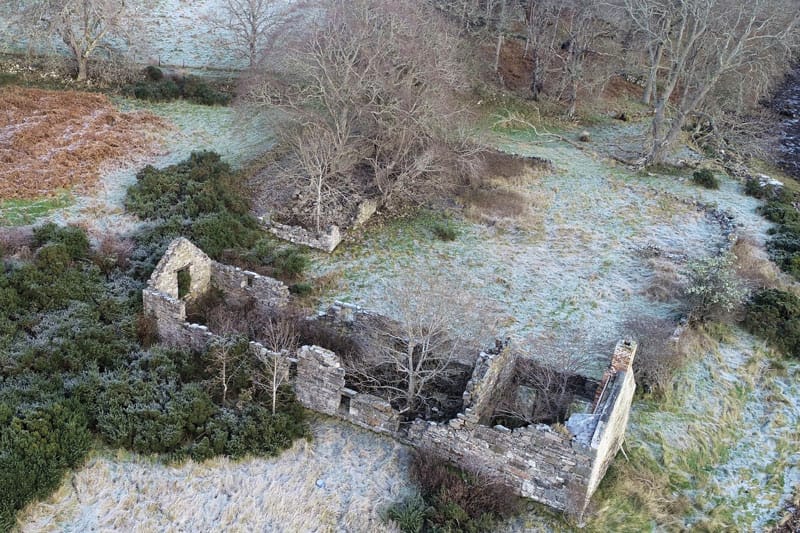
The distillery seems to have failed owing to its inability to procure freshwater of adequate quality, and it also faced the competition from the amount of illegal stills in the area.
Illegal distilleries
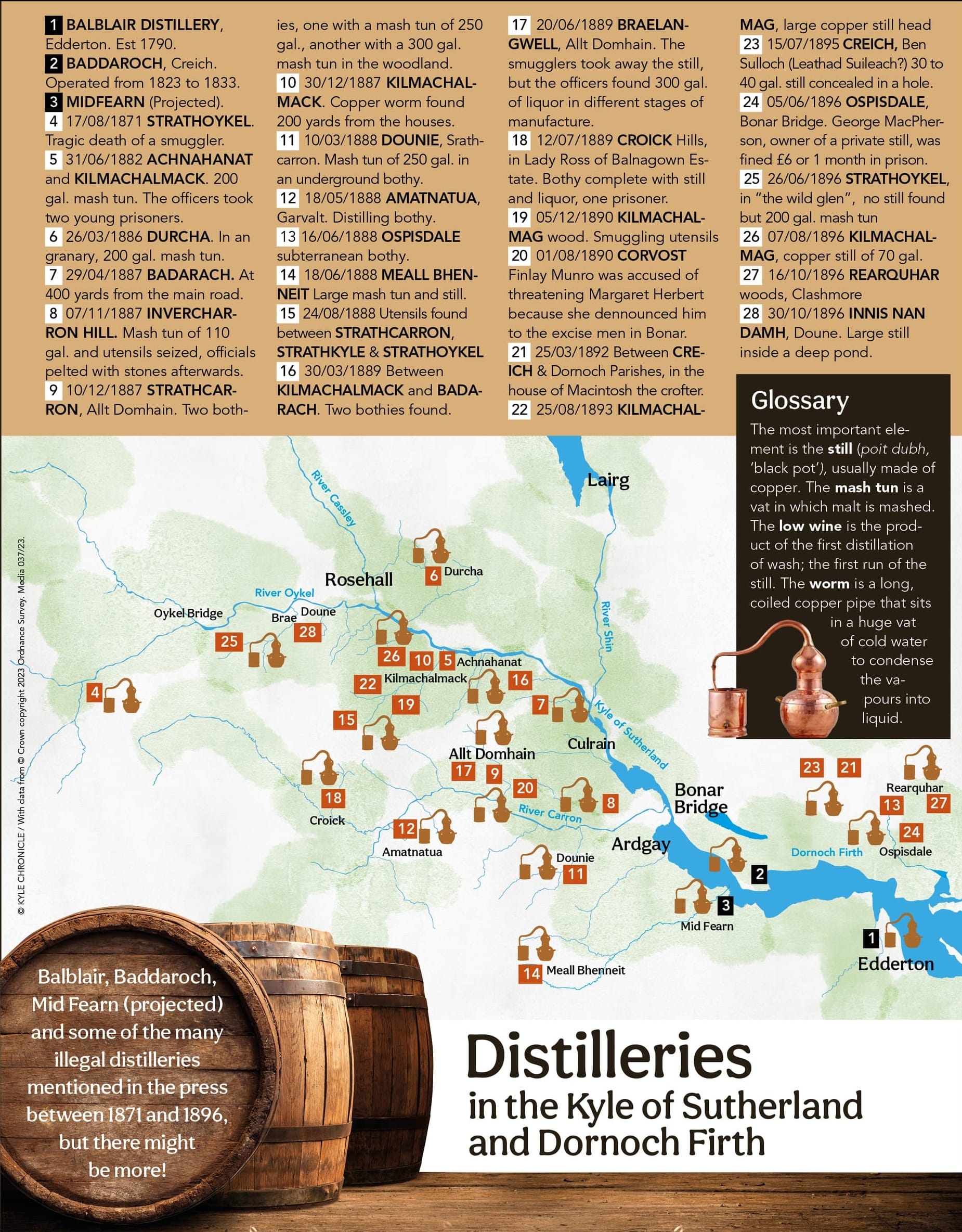
To regulate the spirits market, the government introduced Acts in the 1780s to encourage licensing of distilleries. Unlicensed private distillation was declared illegal, but many Highland tenants depended on the income generated from their small stills to pay their rent. Rev. John Macrae of Knockbain said about their countrymen that “he found nothing more difficult to convince them of than the iniquity of smuggling.” (Ross-shire Journal 13/10/1882).
The south side of the Kyle of Sutherland was perfect for the traffic “as the hills and corries plentifully supplied with streams of pure water are difficult of access” and the scattered population would not give any information to the the revenue officers or “gaugers” (Ross-shire Journal 23/06/1882).
The “smuggling hamlets” of Kilmachalmack and Achnahanat were notorious: in 1887 they found a large bothy near Baddarach, on the estate of Mr Mackay of Glengloy, 400 yards from the road, but they were too late to catch the smugglers or the spirit (Ross-shire Journal 29/04/1887). In 1882, their raid had been more successful. Officers from Bonar, Tain and Beauly surprised the smugglers “in the grey dawn of the morning”, a streak of smoke giving away the location of the bothy. They found a still in full working order and 200 gal. of mash, and made two prisoners: D. Forbes, Kilmachalmag and John Urqhart, Achnagart, although they were not believed to be the real culprits. Another raid in 1887, involving officers from Bonar Bridge, Drumnadrochit and Beauly, resulted in the seizure of a splendid copper worm concealed in a brooklet 200 yards from the houses. During the search, the excise men passed by several bothies, some already discovered, others empty. Also in Kilmachalmag they seized utensils (1890) an unusually large copper still head (1893) and worm (1896).
Sometimes the locations mentioned by the press are vague, for example, they found utensils (mash tun) “in that mountain range which separates Strathcarron from Strathkyle and Strathoykel” (Ross-shire Journal 24/08/1888), and a large copper still of about 70 gallons capacity in the “wild glen” of Strathoykel (Ross-shire Journal 07/08/1896).
In 1887, in Allt Domhain, in Braelangwell, Strathcarron, 13 excise men from Inverness, Drumnadrochit, Beauly, Bonar Bridge and Brora found two bothies. One had been excavated on the gorge of a cascade stream, of difficult access and completely concealed, the smugglers were using a rope ladder in a cleft to get the the goods in and out. It had a mash tun of 250 gal. Another bothy in the woods was found with a mash tun of 350 gals. In 1889, near the source of the Allt Domhainn, the smugglers left behind a fully equipped distillery “and close on 300 gallons of liquor in various stages of manufacture, all of which were poured into the stream” (Banffshire Reporter 20/03/1889).
In 1871, the Fife Herald recounted the tragic death of a smuggler, Robert Ross M’Robb, gamekeeper at Corriemulzie. “Ten or twelve men met in a smuggling bothy in the heights of Strathoykel” and they indulged in their “mountain dew”. On coming back home, Robert fell from the wooden bridge over the river Abhainn Dubhag (“Duack”), 100 yards from its junction with the Einig.
It wasn’t uncommon for the officers to encounter opposition. After setting fire to a bothy in Invercharron Hill, “the officers were pelted with stones, and some of them were rather severely injured.” (Evening Citizen, 07/11/1887). So when officers found an underground bothy in Dounie, complete with a mash tun of 250 gal. and the worm still hot (distillation had taken place earlier that night) and were destroying it, a hostile crowd assembled “and the officers threatened to use their revolvers.” (Ross-shire Journal 16/03/1888). In 1896 in Innis nan Damh near Doune the crowd “not offering resistance or help” watched an officer plunge in the murky water of a deep pond to recover a large still head and worm concealed at the bottom (1896). In Amatnatua the officers set fire to a bothy under the watchful eye of the locals and raided several houses but “no opposition was made to the search and nothing was found” (Ross-shire Journal 18/05/1888).
Perhaps the most succesful operation happened in 1889 in Croick where they managed to find a complete bothy, the still working over a peat fire, and captured James MacLeod from Strathoykel. In Durcha, Rosehall, the overconfident smugglers didn’t bother to build a bothy and used and old granary instead, with a mash tun of 200 gal. (Ross-shire Journal 26/03/1886).
Illicit distilling was also happening between the parishes of Creich and Dornoch, near Clashmore. Revenue officers found distilling bothies in Rearquhar woods (1896) and Ospisdale (1888,1891). And in 1896, George MacPherson, crofter of Ospisdale Muir was fined £6 for having a private still (Glasgow Herald 04/06/1896).