Medieval Invershin
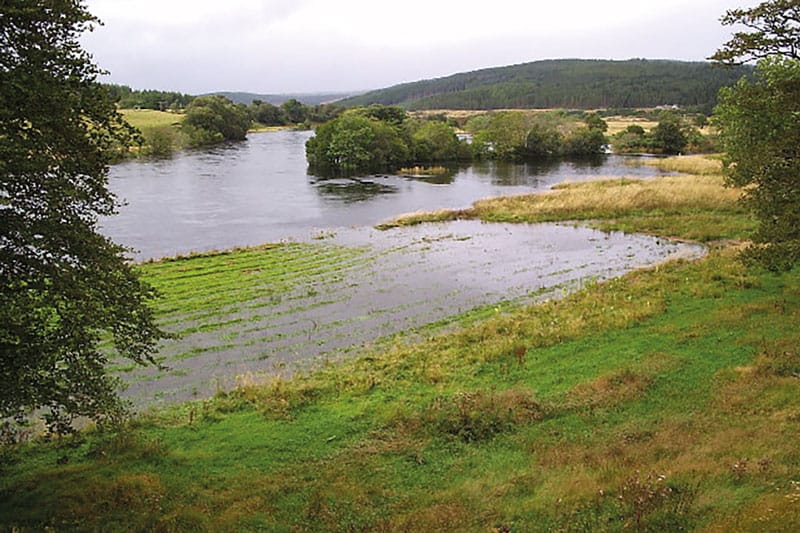
There are almost no traces left of Invershin Castle, which once stood in a strategic spot on the banks of the Kyle of Sutherland. It was built by Hugh de Moravia in the 12th century. A branch of this family, the forebears of the Sutherlands, settled at Dunrobin.
By Silvia Muras (with information from David Watson)
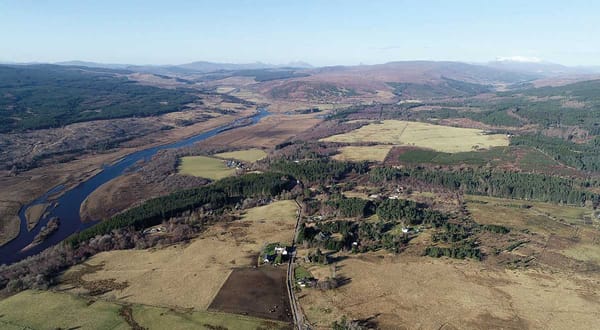
Invershin lies at the confluence of two rivers and a narrow fording site. There are the remains of a burial chamber, burnt mounds, cairns, and field systems from early settlement. There are also remains of a castle on a prominent mound, a standing stone, a burial ground, and history of salmon catching.
Could the castle mound have been the site of previous Brochs or forts? Given its position, could a Norse Garrison Farm have been sited here to protect from Pictish attacks? Could this be an alternative location for Sigurd’s grave?
Standing stone
In a flat field on Invershin farm there is a 1.5m stone on which there are no inscriptions, it is said to mark a grave of a Viking or Norse soldier of repute.
Invershin Castle
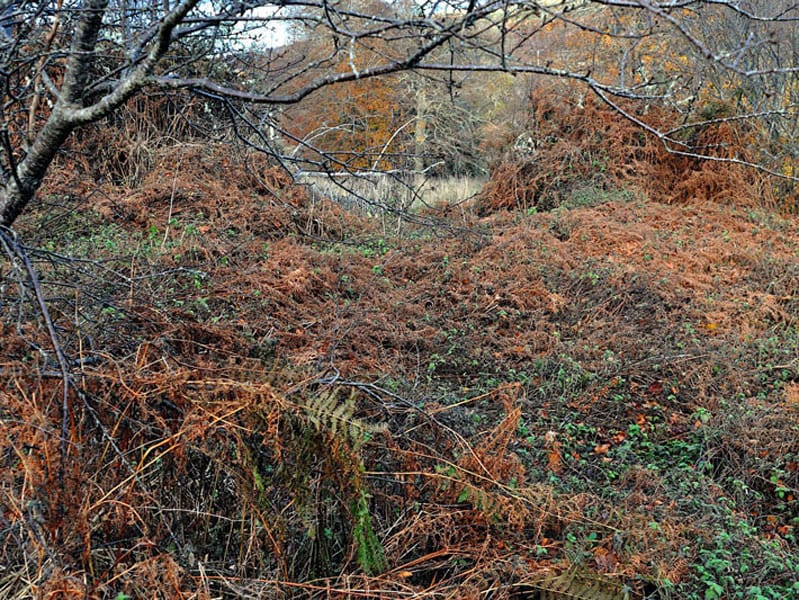
On Invershin Farm grounds stands a pine wood known as ‘castle wood’, as in its centre lie the ruins of Invershin Castle, built by Hugh de Moravia after he was first made Lord of Sutherland in 1210. But was this on the site of an existing fort/castle, was it built on an existing mound?
There is no local knowledge of the history of Invershin Castle. All that remains today is a ‘motte’ site, an either natural or man-made mound, on top of which a timber structure was built - typical of an early Norman (12th century) earthwork castle. Many of these structures were later replaced by stone built castles.
Historically it was known as ‘Castle of Duffus’ an association with Castle Duffus in Moray, a 12th century stronghold of the de Moravias. The adjoining field is known as ‘the castle field’.
Invershin Castle has almost entirely disappeared. The mound occurs on the south end of a gravel spur commanding the flood plain of the Kyle of Sutherland; here the valley is relatively narrow being an obvious crossing point.
The mound is of typical ‘motte-like’ proportions, being 4.0m maximum height, formed by upcast from the dry ditch which surrounds it on three sides; the fourth SW arc is defended by the steep natural slopes of the spur. The flattened summit area is disturbed, probably by stone-robbing, and the only remains of stone-walling is a turf-covered fragment, 0.3m high, in the NW corner, insufficient to enable positive identification as a castle.
The first Earls of Sutherland
During the reign of King David (1124-1153) Freskyn, a Flemish mercenary knight, had come to prominence in Scotland. In 1150 he is credited with destroying the Chisholms, a band of outlaws who had been terrorising the central Highlands. He is said to have chased them north until he cornered them near Dornoch and slew the lot of them. For this service to the Scottish King, Freskyn was given lands near Linlithgow and Duffus, after which he styled himself Freskin de Moravia (Freskin of Moray). Subsequently, Freskyn had built Duffus Castle.
His grandson Hugh de Moravia and his supporters were part of King William the Lion’s army which defeated Donal Ban in 1197 and Jarl Harald in 1201 for which he was created Lord of Sutherland, however this was only honorific as Jarl Harald remained very much in control at this time.
However after King William regained control north of the Oykel, Hugh was given control over Sutherland around 1210. This seems to have been an attempt by the kings of Scotland to replace the native Gaelic nobility, who had resisted their rule.
Hugh built castles at Invershin and Skelbo. Later Invershin was abandoned and more permanent residences were built at Dunrobin, Skelbo and Skibo to control the coast. Hugh was succeeded by his son William who was given the Scottish title of Earl of Sutherland in 1235 and changed his name from de Moravia to Sutherland and became Chief of Clan Sutherland. Invershin remained a part of the Sutherland Estate into at least the 18th century.