Paul Mactire, 'Paul the Wolf'
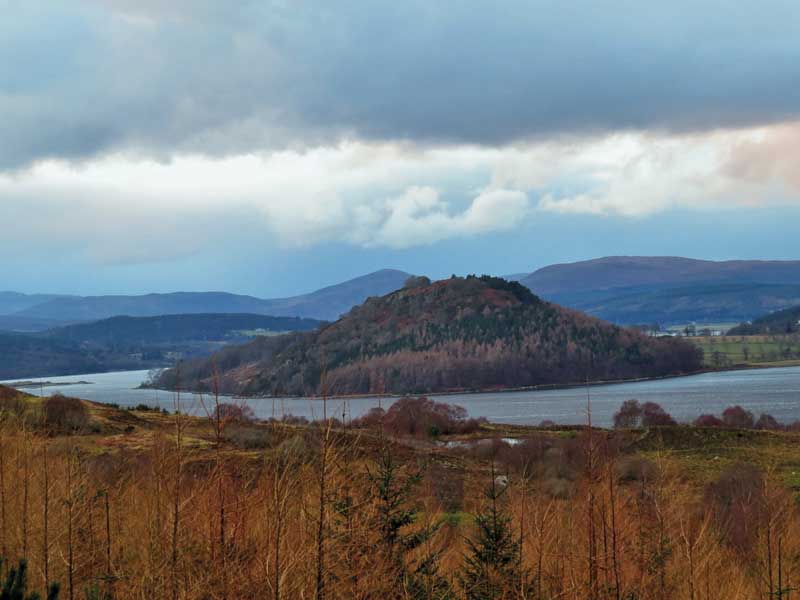
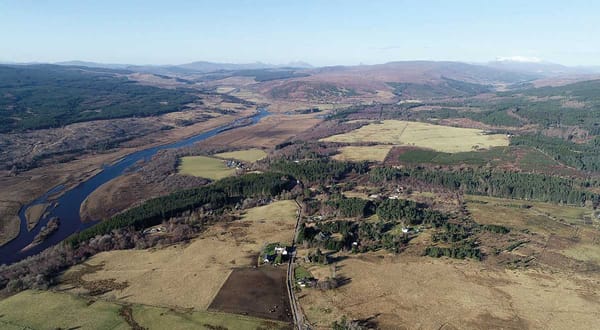
Owner of extensive lands in Strathcarron, Strath Oykel and Gairloch through his marriage to Mary of Grahame, he was a notorious robber or freebooter and centuries old tradition links him to the construction of the vitrified fort on the top of Dun Creich.
Paul Mactire or Mactyre was a 14th century prominent Scotsman (d. Aft 1372) who possessed lands in Creich, Strath Oykel, Strathcarron and Gairloch, and it is said to have been “a very ‘takand’ man, like Rob Roy, [who] levied blackmail on all the district, saving only the charmed spot within the town’s marches” (Fragments of the Early History of Tain, Rev William Taylor, 1865).
Takand is an Middle English word meaning ‘sharer, partaker’ and the “town’s marches” here might be the lands of Creich and Ardgay. Little is known for certain about who he descended from and where he lived. According to Origines Parochiales Scotiae, 1855: in 1341, William, Earl of Ross granted to his brother Hugh of Ross the lands of “Strathochill, Strathcarron, and others, with the fishing of Acheferne and Stogok.” Then in 1365 Hugh of Ross granted to Paul Mactyre and his wife Mariot of Grahame – who was a niece of Hugh of Ross–, and to their heirs, the lands of “Tutumtarvok, Turnok, Amot, and Langvale, in Strathokel.”
The next year, 1366, William Earl of Ross, granted the lands of “Gairloch to Paul and his heirs by Mary of Grahame, for the annual payment of a silver penny in name of blench ferme” (an old form of land tenure), and in 1372, the grant was confirmed by Robert II. To these lands Paul is said to have added “Frievatter”, which alongside Strathcarron and Strathoykel were given in dowry to Sir Walter Ross of Balnagown when he married Paul’s daughter Catherine, retaining for himself the lands around Ardgay and Creich.
Alexander Mackenzie, a 19th historian, and 20th century historian William Skene, believed that Paul Mactire became the Chief of the Clan Ross after the death of the 5th chief, William III Earl of Ross, thus passing the leadership of the Rosses to the line of Rosses of Balnagown. In the manuscript history of the Rosses of Balnagown, Paul is linked to Leandres, a descendent of the King of Denmark. F. W. L. Thomas considers that Leandres might be Sveinn Ásleifarson, a prominent character in the Orkneyinga saga. The son of Leandres was Tyre, and his son Paul M’Tyre, the founder of the Clan Gillanders. The Rosses were long known in Gaelic as Clann Gille Ainnrais (Clan Gillanders).
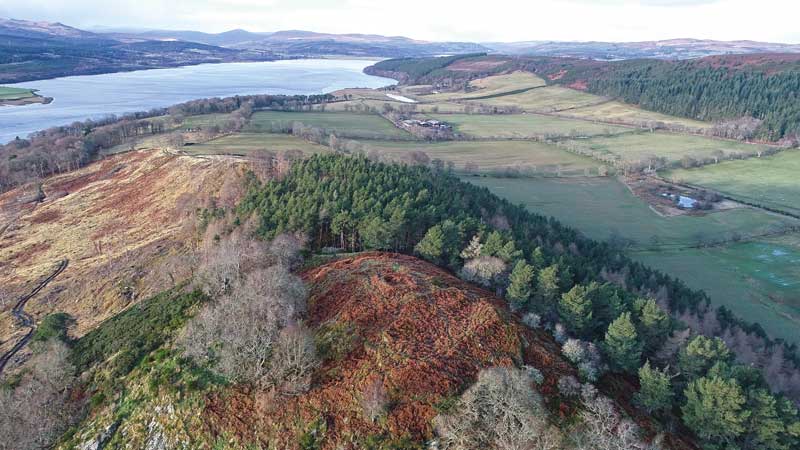
Dun Creich
Sometime before 1630, Sir Robert Gordon of Gordonstoun wrote an historical account which mentioned Paul. Gordon wrote that the ruinous fortress of Dun Creich was built by Paul Mactire, who possessed the lands of Creich and went on to mention that Paul built the fortress with a “hard mortar” which could not be identified even at the time of his writing in the 17th century. He also said that Paul knew of the death of his son in Caithness while he was building the fort, and that’s why he abandoned its construction. In the 19th century, some historians such as John Jaimieson questionned this account, that they saw as an attempt to explain both the vitrification of the fort and its unfinished state.
Freebooting & blackmail
Dun Creich might have been the perfect base for Paul’s activities, which led him to be compared to Rob Roy, collecting “blackmail” from Caithness drovers. It is said that he took as many as 180 cattle annually.
As narrated by Elaine Smith in Addendum to the Murdo Rivach Story (Caithness.org), Paul offered the drovers access to pasture on his lands around Dun Creich. “The cattle forded the Dornoch Firth at Creich below Mactyre’s lookout”. She mentions that in the late 1990s “stones have been uncovered which marked the place for crossing this ford.” Some of the cattle remained invariably in the hands of Paul Mactyre and never made it to the markets in Muir of Ord.
Sir Walter Scott gave a detailed explanation of what blackmail entailed. In his historical novel Waverley, blackmail is described as “A sort of protection-money that Low-Country gentlemen and heritors, lying near the Highlands, pay to some Highland chief, that he may neither do them harm himself, nor suffer it to be done to them by others.” So if a person paying blackmail comes to harm at the hands of another raider, the person they were paying would endeavour to cover their losses, usually by stealing replacements from someone who wasn’t paying them protection money.
Early 20th century Gaelic scholar Alexander Macbain affirms that the Tyre in Paul’s name means “Paul the Wolf”. Apparently the Gaelic nickname Mac’ic-tire was common during Paul’s era, and that the way he behaved towards Caithness drovers may have contributed to his bearing such a byname.
The origins of the word `blackmail´
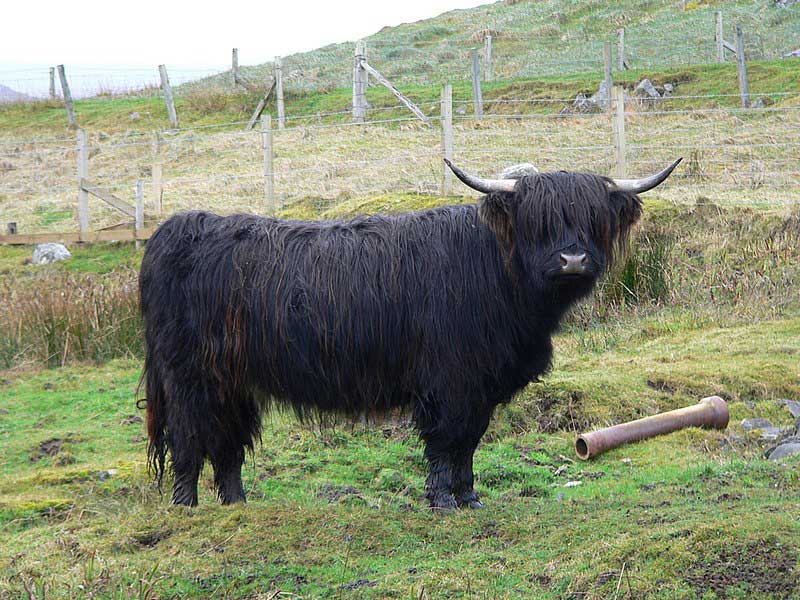
The term blackmail originated in the Scottish Borders meaning a payment in exchange for protection. “Mail” comes from the Middle English word male meaning ‘rent or tribute’. A popular theory linked “black” with the predominant black colour of the highland cattle at the time – instead of the widespread light red and yellow nowadays–. Others, with the black market or black clothes to steal at night. The more probable explanation is given by Charles McKay in the Dictionary of Lowland Scots (1888) who claimed it derives from the Gaelic blathaich (pronounced ‘bla-ich’), meaning ‘to protect’, so blackmail could be read as ‘protection rent’.