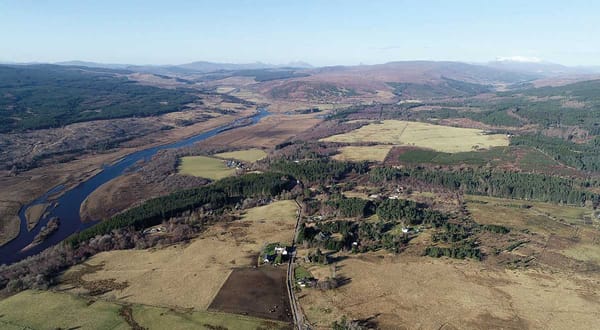
Pine martens around the Kyle
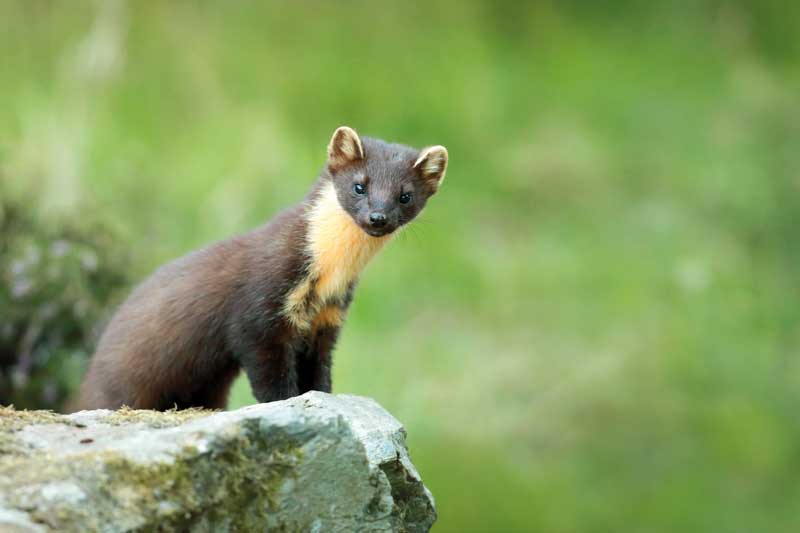
Secretive and rarely seen, the European Pine Marten, (martes martes) is about the size of a cat. It can be ferocious, with sharp teeth and claws which help it to hunt birds and rodents.
By Cherry Alexander
Dark brown on their backs and with a distinctive yellow bib, this is a medium sized member of the mustelids, the same family as badgers, stoats, weasels and wolverines, but it is the only one with semi-retractable claws, which aids its climbing. Measuring 60-70cm and weighing between 1-2 kg, the pine marten, as its name suggests, is a creature of woods and forests. It is found from Russia to Ireland and even into the Middle East. They mostly raise their young in dens in hollows in trees, but have been known to use roof spaces and a friend had a family living under the floor of her house, so they are opportunists in this as well as their diet.
A male pine marten can maintain a range of 33 sq km of coniferous woods or as little as 3 sq km of the more productive mixed deciduous woodland. A female has a smaller range and will not breed until she is 3 years old, when she will have one to five kits, but only breeds once a year. The collective noun for a group of pine martens is a ‘richness’.
Mostly nocturnal, they are the scourge of nesting birds and other small mammals but their diet also includes insects and berries. In the autumn their scats (poo) turns blue from all the blueberries and blackberries they are eating. There is a theory that, because they predate the nests of magpies, jackdaws and other corvids, they are cutting down the amount of songbird predation done by these birds. Pine martens are not uncommon here in the Highlands, and their range is extending. I had one on my wildlife camera earlier this year, and from time to time find their scats in the garden. They are far less common further South and there are programmes to reintroduce them to The Forest of Dean, Dartmoor and Exmoor but they have spread by themselves into Cumbria and Northumberland and a small population has been identified in the New Forest. Wherever they go the grey squirrel population goes down and in some areas, allows the red squirrel to gain a foothold. It seems that the greys are less agile and easier for the martens to catch. The pine marten's main predators in Scotland are golden and white-tailed eagles, goshawks, wildcats and foxes, but most of those taken are juveniles. However, humans and habitat loss probably contributed to why there are so few in England and Wales.
I can see from local Facebook posts that several people in the Kyle area are happy to feed and watch pine martens in their gardens, and there is a charming video of two playing on garden swings, but for interactions in the wild, I asked Vittoria McNamara about her experiences with the martens in Balblair. She has been feeding the red squirrels in the local woodlands for eight years, becoming familiar with different squirrel family groups and during her walks in the forestry she has frequently encountered elusive martens. She has been followed around by them and had one growl at her when she was stood between it and a young red squirrel. Recently, she watched a mother marten playing with her 3 kits. I was impressed by her respect for them; you don’t mess with a mustelid!
There are around 4,000 pine martens in the UK, most of these in Scotland.They were given full legal protection in 1988, having been persecuted for many years. In captivity they can live to 11 years but in reality, it is more likely 3-4 years in the wild.
Forestry and Land Scotland are working on a project to put pine marten nesting boxes along the A9 at Dunkeld in Perthshire in an attempt to stop the invasion of grey squirrels into Perthshire and Aberdeenshire. The martens use the nest boxes and the population in those areas increases, and it is hoped that, because grey squirrels provide a substantial meal, they will work on predating them. The boxes have only been up for a couple of years but are now also being used in Argyll and Aberdeenshire.
I am pleased to see one passing through my wood, or to see one as it crosses the road, but I attribute to them the attacks on my nest boxes; widening the hole on a silver birch one so it is large enough to admit a little owl, and removing all the zinc plate on the nest box hole protectors. For the sake of my birds, I hope they don’t stop long.
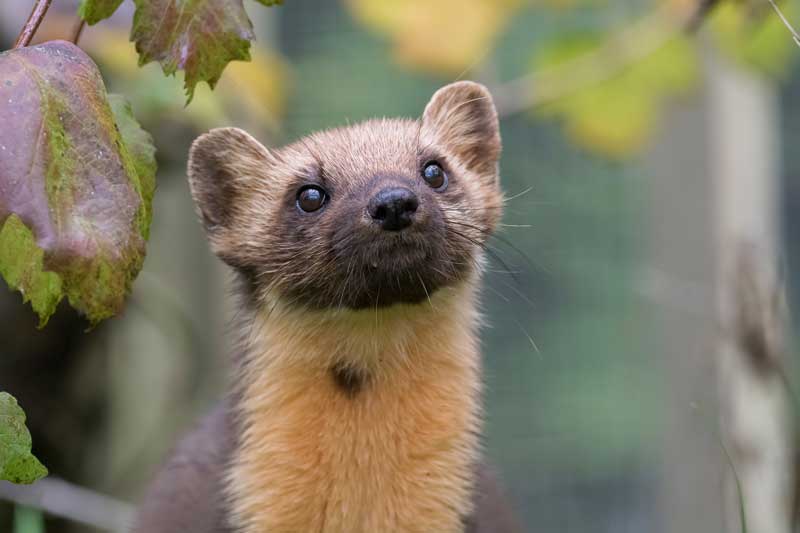
Decline and recovery
There’s evidence that pine martens were being hunted for their pelts from as early as the Mesolithic period, and this persecution peaked in Scotland between the 14th and 19th centuries. This association with monetary value is reflected in their collective noun – “a richness of pine martens”.
In Scotland they almost became extinct in the 19th century, either killed by gamekeepers on sporting estates or because of habitat loss.
The species were given full legal protection in 1988 and they have expanded south and eastwards from core areas in the North West Highlands since, with Scotland’s population estimated at 3,700 adult pine martens. They are once again established across much of Scotland north of the central belt, with some living in the Scottish Borders and Dumfries & Galloway.