Sheep and land use
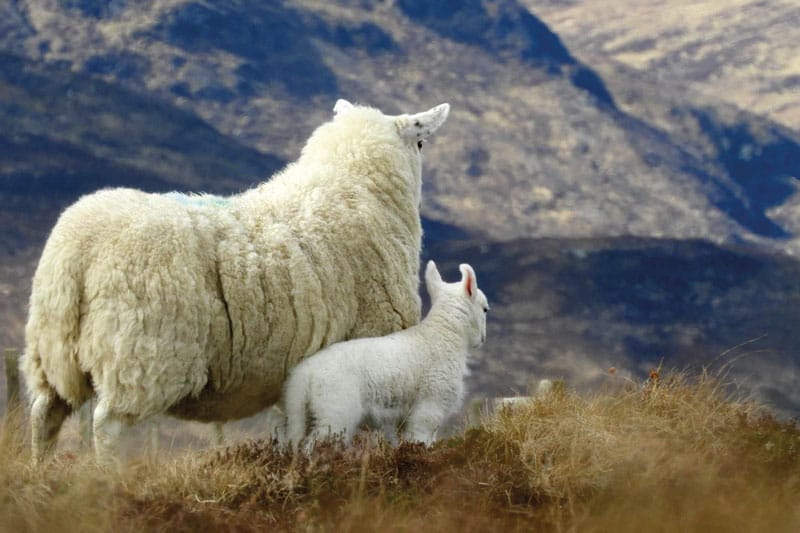
We’ve adjusted our grazing management to increase breeding productivity of our ground nesting birds, most of which are a globally threatened species. The sheep are set stocked over the entire hill part of the croft. This has many benefits for ground nesters.
By George Ross, Heatherlea
Ground nesters upon their return, from migrating south for winter, in early spring they can set up their breeding territories on the croft with ease as with the sheep density being a consistent level across the hill part of the croft, they have plenty choice for location. With the only addition being the lambs that are born from late April through to the last day of May the vegetation is managed well for each species.
‘Improved’ land & wildlife
I’ve been trying to buy my crofts here at Heatherlea for the last seven years – the average timescale is one or one and a half years. A recent letter of support submitted to the Scottish Land Court talks of how my father was a pioneer in hill land reclamation – the ability to turn steep heather hillsides and boggy cross-leaved heath into more productive land by applying lime, using heavy harrows and seeding grass/clover mixes. It was hard and often dangerous work. Some reading this will have known one of Robin’s employees George Pavola, or heard the stories of his daring steep work and his ability to roll a tractor and come out unscathed! Crofters were able to claim government grants to assist with the costs of reclamation which, for example, allowed crofts to go from a few Blackface sheep to, in some cases, several hundred North Country Cheviots, which demanded a better price at market and the wool was worth something too.
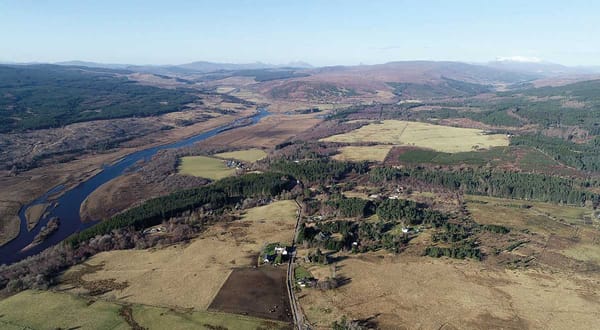
Along with increasing sheep numbers also came an unforseen benefit of increased biodiversity. As the lime improved the pH of the soil that had a thin layer of acidic peat, the soil microbiology improved creating a greater diversity and abundance of invertebrates. As a result waders such as Curlew, Lapwing and Golden Plover all thrived on this improved land. Breeding territories were successful where trees, which could harbour predators, did not exist, and with this new hay meadow-like land being too uneven to consider cutting for hay, then the wader juveniles were safe from the mower. Short-eared Owl, Hen Harrier and even the Barn Owl benefited from this new, ‘improved’ land, with the latter species expanding North into the area partly as a result of this work, along with milder winters in the 90s and by using buildings no longer inhabited by humans.
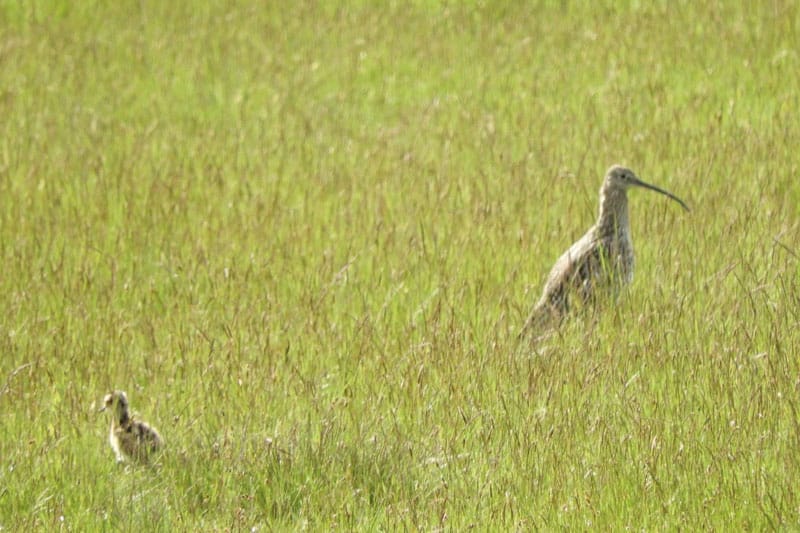
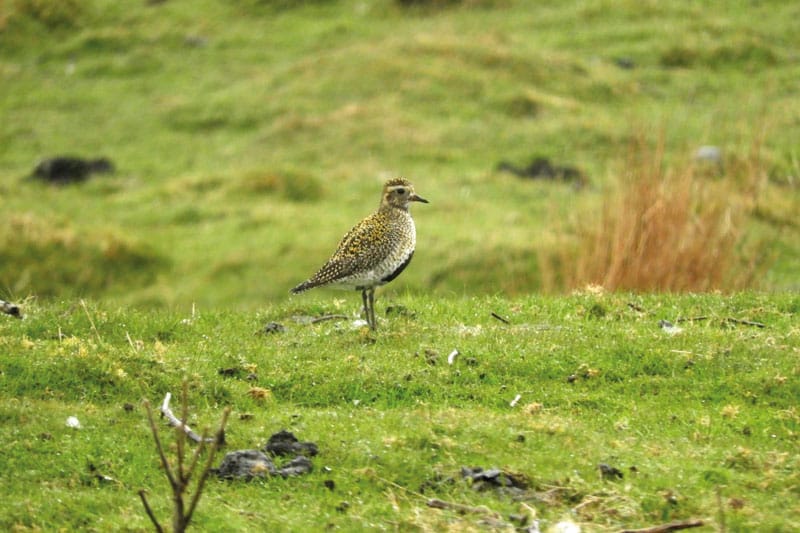
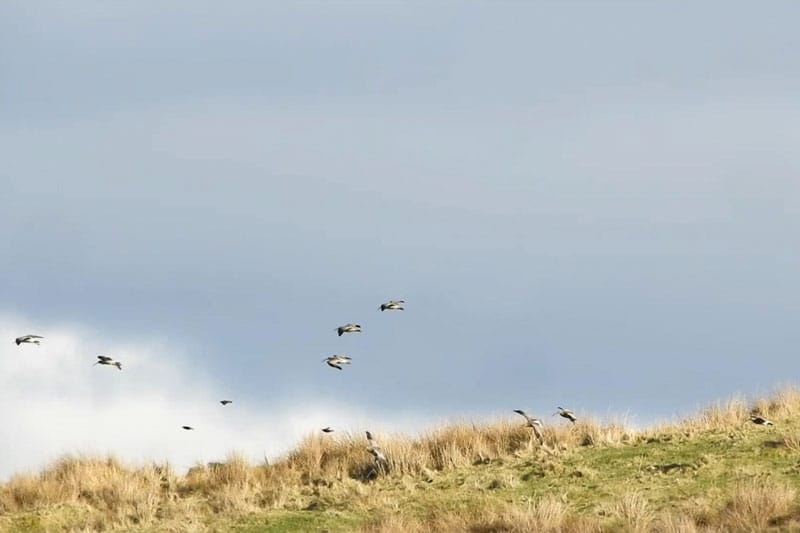
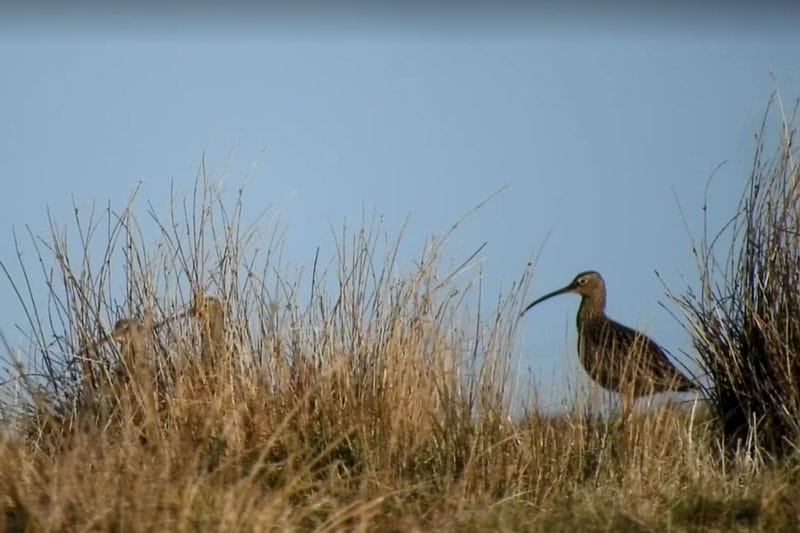
(Left) Curlew adult and juvenile, around the end of May. Golden Plover on the horizon above the sheep fank. © George Ross
In my area in the last few years I’ve witnessed very successful breeding pairs die out due to buildings either loosing their roofs or being renovated to become holiday lets, removing the dependent wildlife and the potential for locals to live locally. For example, prior to being renovated one house had a pair of barn owls that successfully fledged two broods in one season, each seven strong and were ringed by friends from the British Trust for Ornithology (BTO).
There are four main threats to our upland waders: forestry, too many grazing animals, too few grazing animals and wind turbines (collision, habitat loss).
The threat of forestry
Ground nesting birds, such as our waders, will not nest in or within 500m of woodland, be it broadleaf or conifer, due to predator threat.
With gigantic new forestry targets (46,500 hectares by April 2025), most of these new woodlands are subsidised and allow their owners to sell carbon credits. From forestry there is no way back to agricultural production. We are encouraged to become more self-sufficient, not relying on food from abroad, yet policies are also encouraging a change in land use towards rewilding, renewables and forestry, with agricultural land being planted with trees as a result.
Carbon stored in the soil by our grass grazed sheep will escape into the atmosphere as soon as an excavator digs the tree mounds. A scientific paper published in 2020 (Tree planting in organic soils does not result in net carbon sequestration on decadal timescales. Global Change Biology, 1–11) explains how upland afforestation can be more harmful for the environment than leaving it in the current grazing system. The key points of the paper were:
- Three native species of trees, two birch and one pine, were planted onto heather moorland at four sites in Scotland to calculate the change they cause in carbon levels.
- Tree planting did not lead to an increase in carbon within the ecosystem over 12-39 years after planting. There was even a loss of carbon at one site.
- Tree planting caused greater soil respiration and lower levels of carbon in the soil, when compared to pre-existing heather ground cover that was unchanged and not burnt.
- The loss of soil carbon cancels out the increase in the tree’s biomass carbon over decades.
- This is relevant to current policies, which promote tree planting to ease climate change.
- The change in carbon levels needs to be better understood and quantified so the impact that large-scale tree planting has on existing soil carbon levels can be measured and the intended outcome can be achieved.
Crofting & waders
My mother encouraged me with the wildlife and, for many years now, my wife Sabrina and I have been working towards creating a wader utopia! Avoiding the financial temptation of tree planting to keep our croft land open and free of predators. We have been creating scrapes which are small, shallow ponds essential for juvenile waders to feed around the soft edges on insects. Instead of using the more productive “paddock” system for grazing our sheep, a system designed in New Zealand and adopted over here to make the very most from every blade of grass and increase lamb live weight gains, we have gone for a more biodiversity-friendly approach. By appropriately setting our stocking rate and keeping it set for the entire breeding season we are able to increase wader breeding productivity as the pairs that lay, incubate and rear in an environment where birds feel at ease and trampling does not occur. The grazing sheep keep the vegetation just right and unlike with paddock grazing our grass is allowed to seed meaning there is plenty cover to hide juveniles from predators.
Removal of upland sheep would spell the end for ground nesting birds, with their iconic songs and calls dying with them. We must as a Scottish crofter, producer of Vitamin B12 rich natural protein lamb and as a member of the public, remember that the reason these rare birds have chosen the land on which we work is because of the grazing of upland sheep.
If sheep were removed from the uplands, and say allowed to degrade (“rewild”), then not only would the rural populations struggle to sustain a life here, but the rich variety of biological diversity we as a member of modern society are meant to be encouraging and protecting, will also fail to return, further pushing the species toward the brink of extinction.
A few concerns there about the future of the croft, its reliant biodiversity and our crofting community. I am hopeful that by me sharing my experiences, a healthy open debate can be had to help shape the future of our crofting community.
George Ross, Heatherlea