The Anderson family of South Bonar
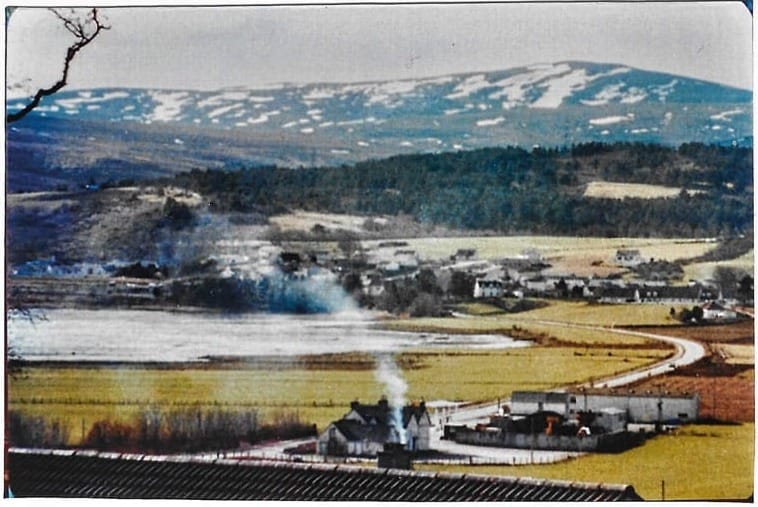
In the industrial estate there once stood a building, informally known as the “Pink House’. The house –originally the Ardross Inn– was owned by the Anderson family who farmed Lower Gledfield and also owned a pier, a sawmill and a coal yard, and operated the salmon net fishing.
By Katharine Broome
Nearly two hundred years ago, my great great uncle, Andrew Ross, arrived in Ardgay to take over the tenancy of the inn, the Balnagown Arms. Born on July 7th 1792 in either Swordale or Clare in the Parish of Kiltearn, he was the youngest of the eight children of William & Isabella Ross who were married at Teaninich in the Parish of Alness on March 11th 1785. William was a crofter and chair maker.
Andrew gained employment with the Sutherland and Taylor families of Dornoch and Tain. In 1821, the eighteen year old Robert Sutherland Taylor – later Sheriff Clerk of Sutherland – went to Glasgow to study law and Andrew accompanied him as his manservant.
In 1823, Andrew married Roberta Sutherland at Rearquhar near Dornoch. According to her death certificate, Roberta was born in Inverness in 1784 to an unknown mother and Andrew Sutherland. He was the brother of Wilhelmina Sutherland, born in 1768 who married William Taylor, 1766-1829, Postmaster and Sheriff Clerk of Dornoch (1809-1829) the parents of young Robert. The Marriage Register for the Parish of Avoch shows on April 29th 1823 the names of Andrew Ross, Butler from Glasgow and Roberta Sutherland, housekeeper Avoch House.
“That Andrew Ross Servant in Glasgow, and Roberta Sutherland, residing in the Parish of Avoch, Ross shire have been proclaimed in several of the churches here, in order for Marriage, three several Sabbaths and no objections made is attested at Glasgow, the fifth day of May one thousand eight hundred and twenty three years by Robt Strang, Sess.Clerk Dornoch the sixteenth day of May 1823”
Her father was not present. Robert Sutherland Taylor’s diary tells that Andrew Sutherland visited Dornoch from October 22nd 1822 until April 20th 1823 when he went to London on his way back to Jamaica where “he had already been for forty-three years.[sic]” Taylor describes him as “only surviving brother of Mrs. Taylor.” Andrew Sutherland had six children in Jamaica. He died on December 24th 1840 and was buried in the Scotch Burial Ground, Kingston.
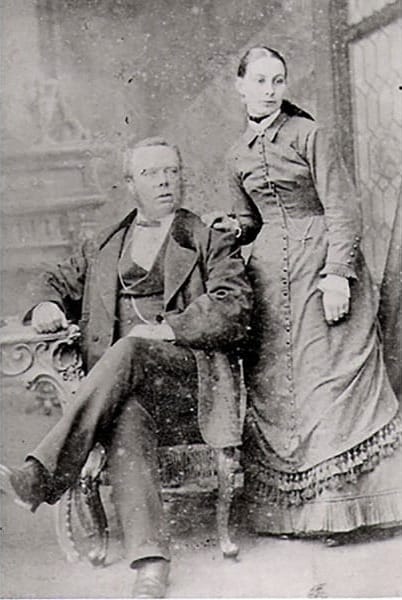
The date on which Andrew Ross took the tenancy of the Balnagown Arms is not known but a Recognition by his nephew George Anderson, South Bonar dated 1876, states:
“I am Tacksman of the quay at Bonar Bridge. The first quay a small one was made there about 40 years ago by Andrew Ross the then tenant of the Balnagown Arms at his own cost. He was tenant of the Balnagown Arms and also of the farm of Lower Gladfield which belonged then either to Mr. Mathieson of Ardross or to the Duke and which belongs now to Mr.Mathieson. Ross built the pier at his own cost and it was just to serve the neighbourhood.”
Andrew Ross was granted the Tack of Gledfield on 22nd September 1834. A Memorial dated 26th November 1841 for Andrew Ross Tacksman of the lands of Gledfield in the Parish of Kincardine Ross shire – the Property of his Grace the Duke of Sutherland states
“the late Duchess Countess of Sutherland [who was well acquainted with the Memorialist’s wife’s father when Proprietor of Uppat] condescendingly desired his wife some weeks after he became tenant of Gledfield, to ask Her Grace for any thing she might have it in her power to do for her comfort, or the advancement of her interest in life, a permission, however, of which no advantage taken, the Memorialist and his wife not having contemplated their removal from Ardgay Inn previous to the lamented death of the Duchess Countess.”
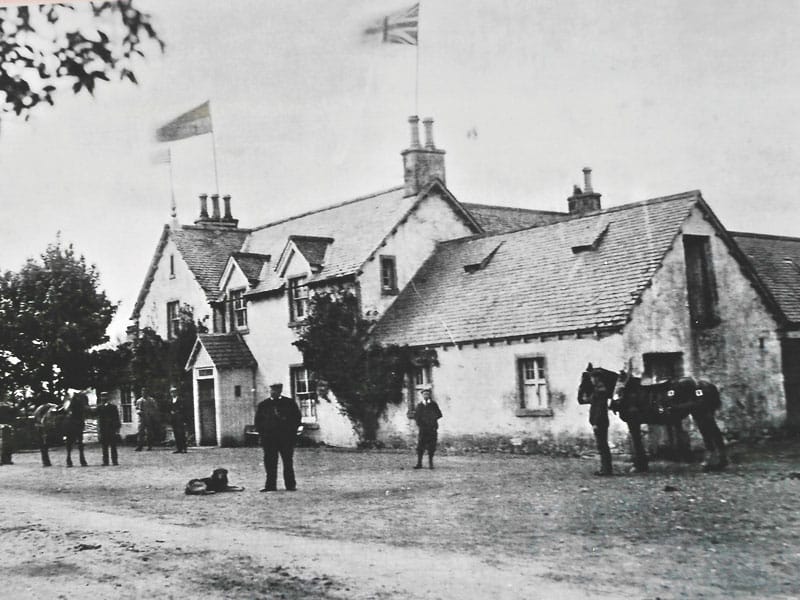
She had died on January 29th 1839. At the time of the 1841 Census, Andrew & Roberta were living at the Ardgay Inn. It may be surmised that the young generation were changing tenancies.
Andrew’s name is on a Roll of Special Jurors for the Eastern District of Ross-shire in the General Jury Book 1845 & stated “of Gledfield now at Glastullich”. The 1851 census shows them living at Newfield, Glastullich in Logie Easter, a recently built house designed by the Maitlands of Tain and described as “a very superior dwelling house, equal to any in the district”. Andrew farmed 400 acres and employed 19 labourers.
Roberta died at Glastullich on March 17th 1855. On April 17th the following year, he married her niece Johanna Taylor MacEwen. She was some 39 years younger than him. Andrew died at Glastullich on January 9th 1872 leaving a son and two daughters, all of whom are buried at Logie Easter.
One of Andrew Ross’s sisters, Mary born in Kiltearn in 1786 had married a local boy, John Anderson, at Kiltearn on January 2 1824.
In his Recognition of 1876, my grandfather, George Anderson, stated that he was brought to the Bonar area about 40 years earlier when he was six. (He was born on 26th December 1828.) His parents had been running an inn or spirit house in Alness. No doubt, through the connections of Mary’s brother, Andrew, they were offered the tenancy of the Ardross Inn at South Bonar.
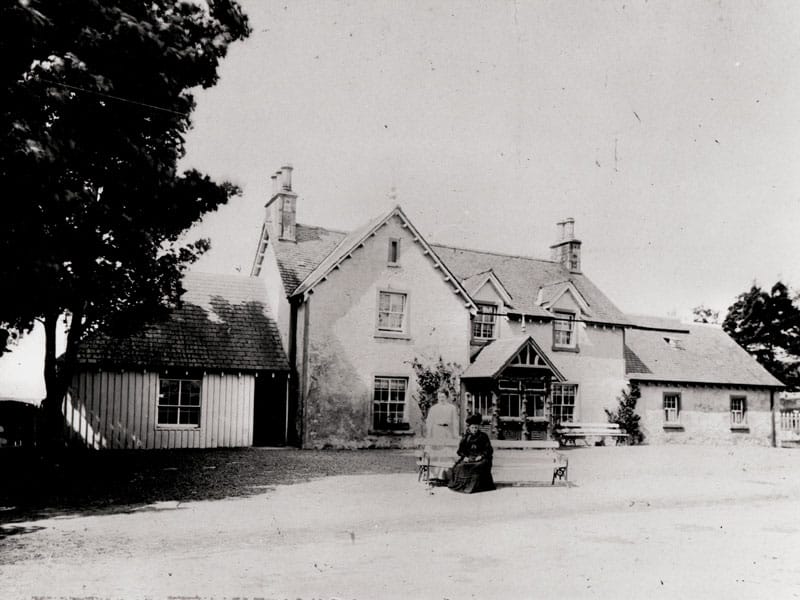
They had another connection in the area as John was a first cousin of George Anderson, 1798-1887 who was the miller at Gledfield. They were grandsons of John Anderson & Christian Campbell who were married at Drummond, Kiltearn on 21st June 1746. Both were servants to Robert Douglas of Balcony.
John died in 1840 aged 53, leaving Mary with five children. She continued to run the business until the mid 1850s when my grandfather bought the inn and it became a private house. Mary bought Cherry Grove in the village of Bonar and died there in 1871.
My grandfather was married three times. His first in 1856 was to Ann Munro a daughter of Robert Munro, merchant in Bonar. Of their five children, their eldest, Euphemia, was drowned in 1868 aged 11 in the Carron with Ann Brown. As did many young men of the area, two sons emigrated to the United States and one to Australia. None have descendants.
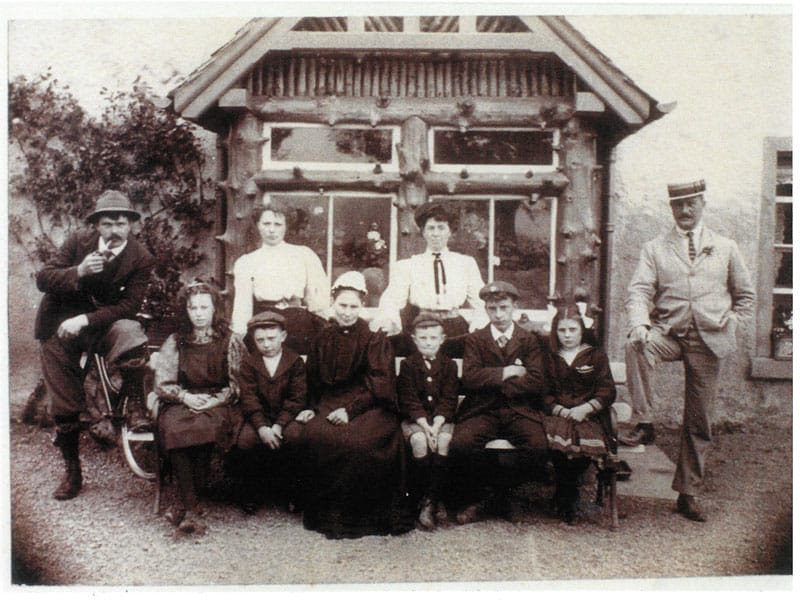
His second wife, Ann Simpson Ross, was a daughter of Alexander Ross, the postmaster in Ardgay. She was eighteen years younger than him when they married in 1871, two years after the death of his first wife. Of their two sons, one died young and the other without descendants married a niece of his mother.
His final marriage was in 1877 to an even younger wife. Emily Jane Anderson was twenty one, twenty eight years younger than him. She was his second cousin being the daughter of George Anderson, Gledfield. Of their nine children, seven grew to maturity. Their elder daughter, Annie Mina, brought the connection to the Balnagown Arms in Ardgay, full circle.
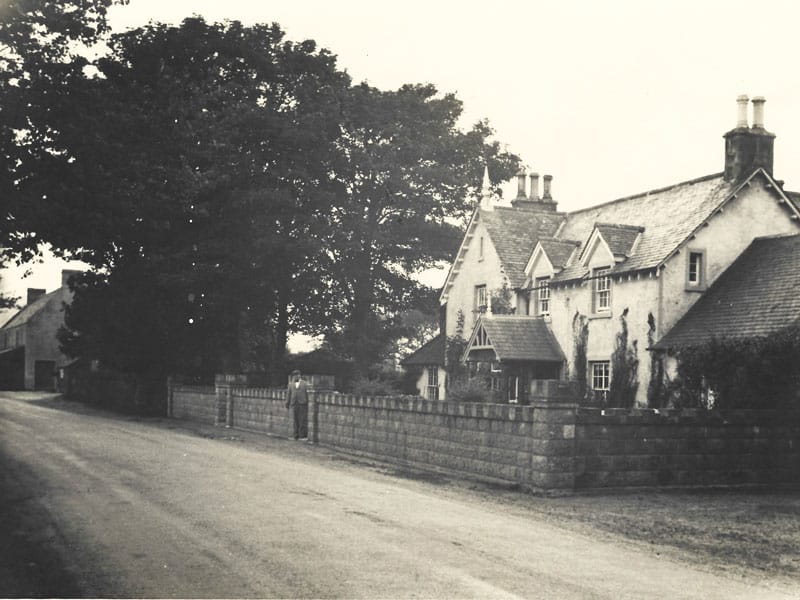
Born in South Bonar in 1880, she married Ferguson Sutherland Macleod. His uncle John Macleod, born in Helmsdale in 1849 married a Donaldina Ross (no relation) in 1881 and took the proprietorship of the Balnagown Arms in the early 1880s. John died in 1922 and his nephew, Fergus Macleod, succeeded him. Donaldina Macleod and her sister, Jane Ross had bought Ardgay House in 1913. The lived there until the last of them died about 1940. After the Balnagown Arms burnt down, Mina and Fergus Macleod bought Ardgay House which had been inherited by a Canadian niece of the two sisters. Mina died there in 1963 and Fergus in 1969.
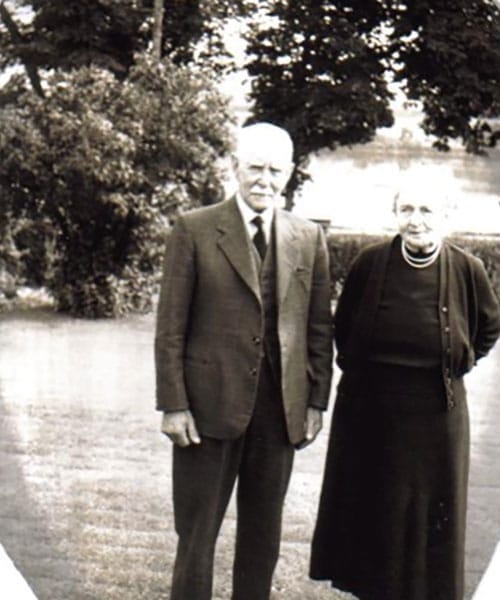
The last of the Andersons to live at South Bonar was Rebekah Ross Anderson, always known as Ruby. Born on Christmas Eve 1888, she died there on 16th March 1959.
Amongst the numerous descendants of William and Isabella Ross who married on that March day in 1785 is Justin Trudeau, Premier of Canada, their five times great grandson.
Thomas Urquhart who was for many years Locomotive Superintendent of the Grazi-Tsaritzin Railway in South Russia, died at Delny House, Delny, on the 8th July 1904 was their great grandson and John Leslie Urquhart (1874–1933) a mining entrepreneur in Russia who escaped at the time of the Revolution, was a great great grandson. His father, Andrew Urquhart had been in the liquorice trade in Smyrna. Both Urquharts were descended from two daughters of William and Isabella Ross. They married two brothers of an Urquhart family who were coopers in the parish of Kiltearn.
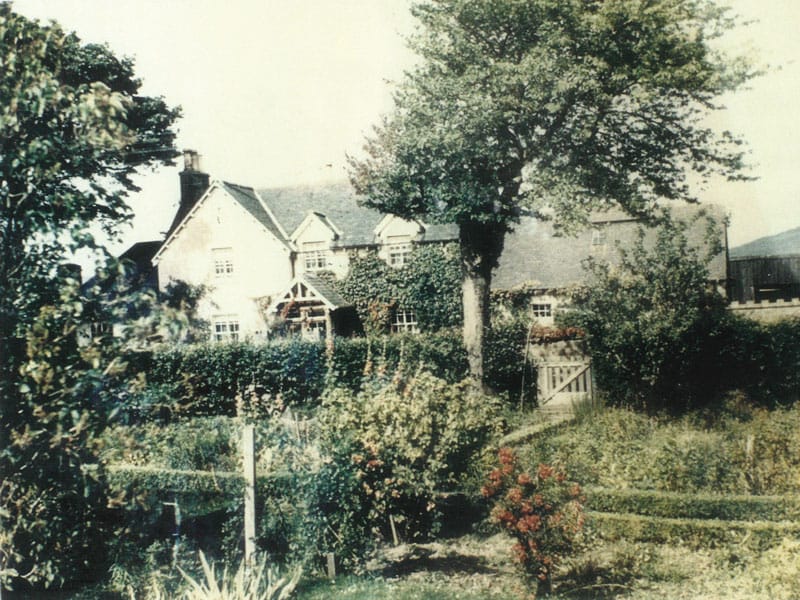
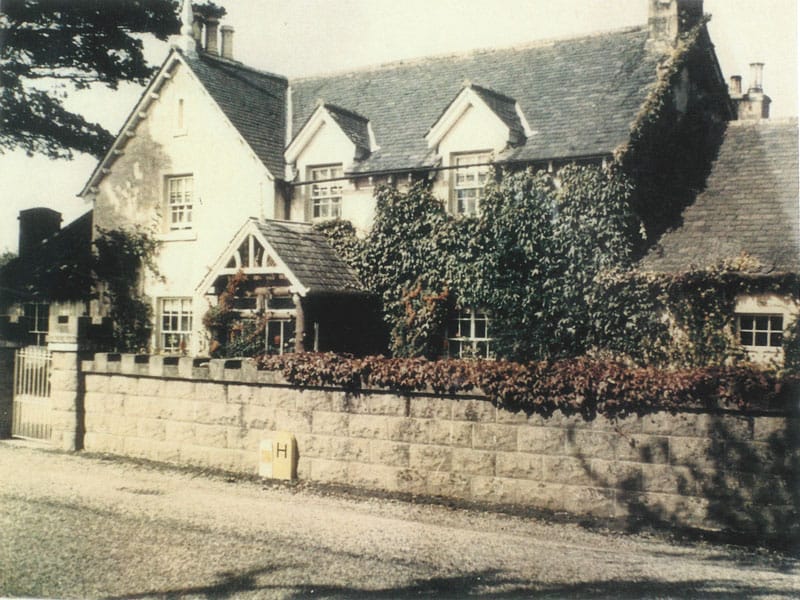
South Bonar garden and front. © Wallace Sinclair
Snowdrops and aconites
Spring flowers growing in South Bonar are traces of Miss Anderson’s beautiful garden. In 1992, when plans to build the picnic and car park area were under way, an article in The Northern Times remembered the once busy industrial hub: the sawmill was located near the pier, employing woodcutters, carters and sawyers. There was also a coal yard, outhouses, stables and stores. Before WW2, up to 50 men worked in the salmon net fishing during the season (March to September). In winter, it was time to repair the boats and cut the ice from local lochs, specially kept free of weeds. Local ice houses (Ben Reay, Ardgay and Bayview, Bonar Bridge) were always well stocked.