The Army Bridge over the River Oykel
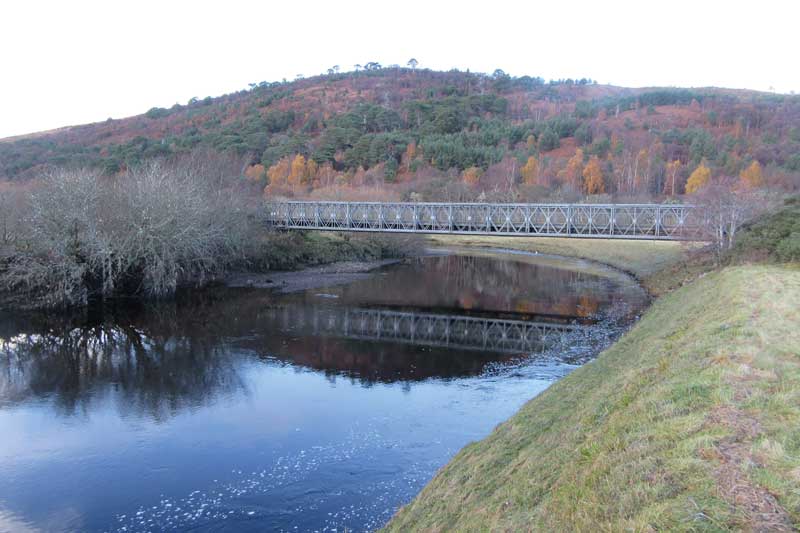
Built by 66 Plant Squadron Royal Engineers in July to September 1975, under the Army´s Military Aid to the Civil Community scheme, it has proven hugely beneficial in revitalising the strath and improving communications for those living here.
By Colin Gilmour
If you cross over the Bailey bridge, which spans the River Oykel about a mile west of Rosehall, and stop in the centre you will notice a brass plaque which reads, “Built by 66 Plant Squadron Royal Engineers: July to September 1975”. Locally it is still known as The Army Bridge and what a difference it has made to the strath since then.
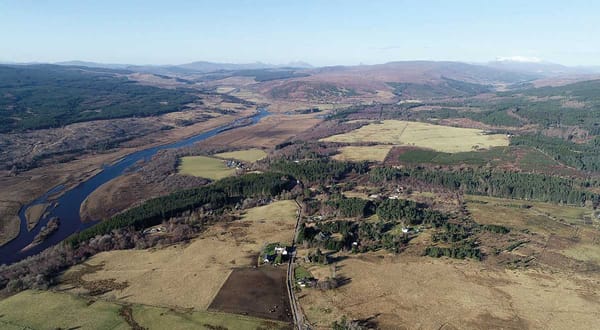
Prior to its existence, the only public road to Ardgay was down the bendy single-track road past Carbisdale and over the River Carron or, for those with a Landrover or equivalent, one could ford the Oykel river in one or two places. On foot one could cross over the suspension bridge at Tuitim. George Ross, who was fishing manager on the river for many years, recalls that his father, who lived at Doune, tried as an experiment to take his Austin Seven across, got almost to the other side, but then found the width narrowed, so had to reverse with great difficulty.
The road journey from Brae to Rosehall via Ardgay measures 25 miles and in 1975 took, and indeed still takes, a good hour by car, whereas via the Army bridge it is 3 miles and takes eight minutes.
Up until 1975, the lack of good road communications meant that few people lived between Culrain and Brae and some of the existing houses were either no longer lived in or had become dilapidated. Colonel Sir Allan Gilmour of Rosehall was a Sutherland Councillor at the time and saw a need for a bridge over the River Oykel near to Rosehall, as a means of revitalising that part of the strath and improving communications for those still living there.
Using his military connections, he asked if the Royal Engineers would like to build the necessary approach roads and bridge under the Army’s Military Aid to the Civil Community or Op MACC scheme, which was functioning at the time. Under Op MACC, Royal Engineers would bid for such work as part of their training.
Everything fell into place and the project started in July 1975 and was completed in early September, with 66 Squadron providing all the labour, the plant (JCBs, bulldozers etc) and the actual Bailey bridge. The squadron camped on the flats near the river and so were on the spot for the job.
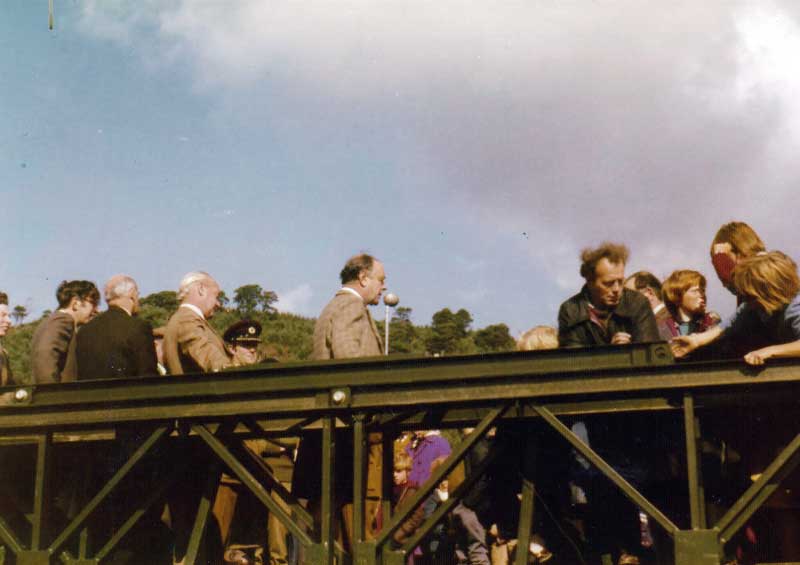
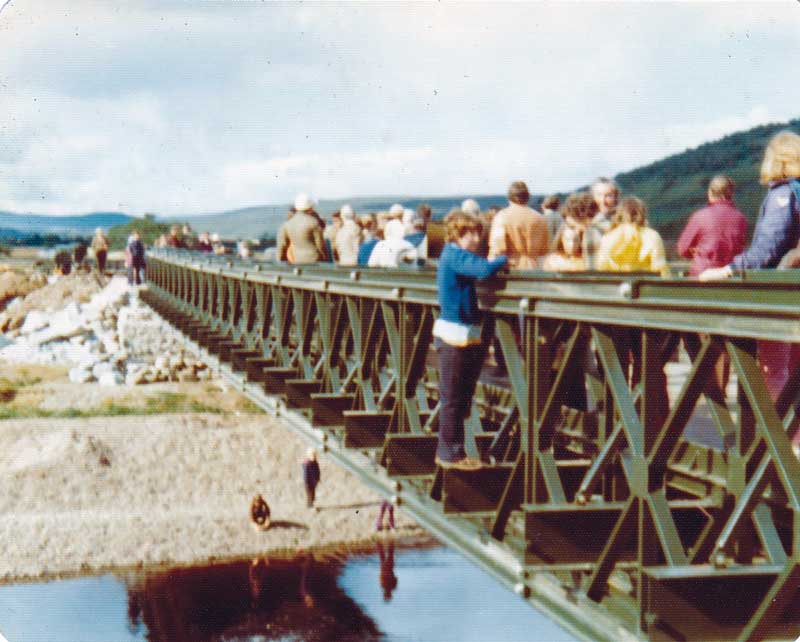
Colonel Gilmour opens the bridge and spectators at the opening ceremony. © Colin Gilmour
The position of the bridge just downstream of a bend in the river was carefully selected, as there were concerns that any structure could be taken away in a massive flood. Indeed, the story goes that Mr Graesser of Rosehall House had a bet with Colonel Gilmour that the bridge wouldn’t last the first big flood, but the passage of time has proved him wrong! The engineers did a marvellous job constructing the foundations and shuttering for the bridge to rest on.
The Bailey bridge
The concept behind the Bailey Bridge, designed in 1940 by Sir Donald Bailey the English engineer, was to provide a temporary bridge that could rapidly and manually be erected in war-time conditions and that could sustain the load of heavy tanks and other vehicles. Its principal characteristics are standardisation, the simplicity of panels and readiness of assembly in the field. There are only seventeen parts used in making the bridge itself, and another nine in constructing the supports on which it rests.
However, it is the method of “launching” that makes the Bailey bridge so novel. Each three metre section is built up on shore, complete with roadway, then pushed forward on special rollers, which are part of the equipment, almost to the point of balance. The next section is then added after which the bridge pushed forward again. A false “nose” is fixed, and when this has crossed the gap, it is given support while the final panels are completed; after which the “nose” and rollers are removed, so that the bridge can be locked in position.
Official opening
The bridge was opened the day after its completion with Colonel Sir Allan Gilmour cutting the tape. Following the Royal Engineers’ tradition on completion of such a project, the Squadron commander was picked up by his men and thrown, in his uniform, into the river.
While it has taken time for the revitalisation of the strath, this bridge has meant that there has been a repopulation, with many of the old houses and crofts modernised and several new ones built. Over the years the Army bridge has indeed proved hugely beneficial.