The great snow of 1978
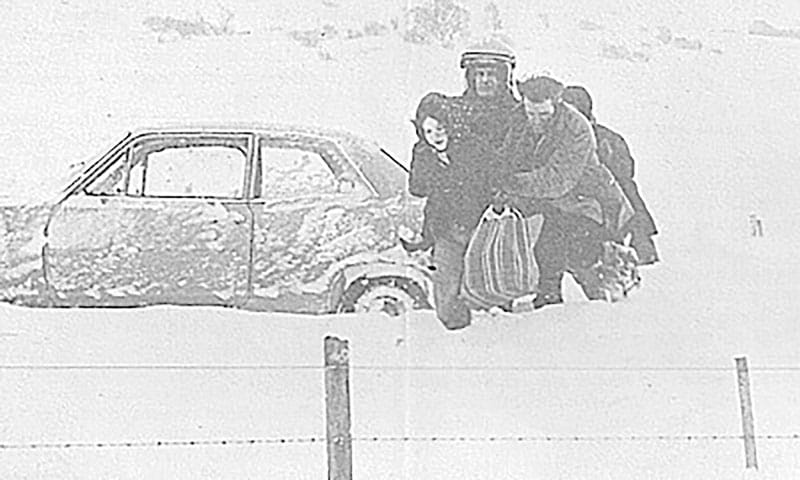
Uisdean Vass recounts his personal experience of one of the deadliest snow storms across the North of Scotland, with four lives lost as a direct result of the snow blizzard and thousands of people without electricity, telephone and supplies for more than five days.
By Uisdean Vass
I suppose I don’t remember much about Friday, 27 January 1978, before 7:00 pm on that day. I was a sixth-year pupil in Golspie High School, and I had taken the weekend bus to Lairg before being picked up by Percy Vass, my father. We lived in Rosehall Schoolhouse. My mother Joy was the Headmistress of Rosehall Primary School. On the way over the hill to Rosehall from Lairg, I visited an old gentleman in Gruids to interview him for a paper I was writing for Sixth Year Studies History. Time rolled on and my father got impatient. At last, we set off and got home without incident. Within an hour the heaviest snowfall I can remember began and the hill road to Rosehall from Lairg became impassable for weeks. In fact, no vehicle got as far as Rosehall until the end of the following week (beginning 29 January) and power was off for that whole week. We were marooned! What fun!
I often tremble to think what might have happened if we had waited another hour to set off for Rosehall on the Friday night. I am sure that we would have become trapped in snow up at the Lochans on the top of the road. There were no mobile phones in these days. My father was an ill man. But that was not to be.
We woke up on Saturday to find that power was gone. The drifting snow was stunning in its power, and very beautiful. For one of the rare times in my life, I knew that the weather was very dangerous. My job was to get the fire of peats and blocks on immediately and with it our fire-kettle. Then I made tea for the house. Dad was an ace with tilly lamps and soon the whole house was beautifully lit. He was also a great fire cook. On the Sunday he cooked a roast chicken and roast potatoes on the open fire. He also made his own bread, which went down a treat with our home-made bramble jelly. The week was a week of splendid isolation. I was the only one leaving the house to traverse the drifts. I love the light cast by tilly lamps, but I don’t enjoy getting these lights to work! Deep lying snow gives me a feeling of restfulness and well-being. I have the happiest memories of the week.
The next day, the roads were completely impassable so we walked the whole way to the Post Office on top of dykes
I ventured out in the Saturday afternoon dressed as if I was trying to reach the South Pole. I trekked through the fields to see my old friend Johnny Matheson of Mid-Altass. Johnny was out working with his cattle and my hat was carried away by the wind and deposited on top of his manure heap! Listening to Johnny’s old battery radio, I gathered that Rangers had beaten Berwick Rangers 4 to 2 in Berwick. As a Rangers supporter, that was an important score for me as Berwick had knocked out Rangers 1 to 0 in Berwick just over ten years before. Rangers’ loss to Berwick in 1967 was arguably the most famous Scottish Cup result in history. Strangely enough, the Berwick goalkeeper of the 1967 game, Jock Wallace, became the Rangers manager of the 1978 game.
The next day, John announced his intention to visit the Post Office and see Mrs. Maclean who was the post-mistress. The roads were completely impassable and so we walked the whole way on top of dykes. It was extraordinarily beautiful to see the dark skies looking north and to inspect the pristine drifts which lay flat across the roads to the top of dykes. Johnny was walking ahead of me and talking. Along the way I slipped and fell into the drift. Clambering out, I saw him ahead, talking away, not knowing that I was even gone. I very much regret not taking pictures of the Big Snow, but taking pictures was much more of a “process” then. They didn’t just appear on your phone!
When we arrived at Mrs. Macleans, I found that I had a letter from the University of Strathclyde offering me a conditional place in the Law School. When I finally did go to Edinburgh later in the year, I told a great story that I walked over a fifteen-foot drift to get my first university offer. At the same time, I remember pushing further east in Altass and visiting Ms. Edie Ross in her lovely crofthouse. Ms. Ross was there with her sister Mrs. McTavish. They put out a tea to die for and also a wee drop of the special stuff.
Tragedy
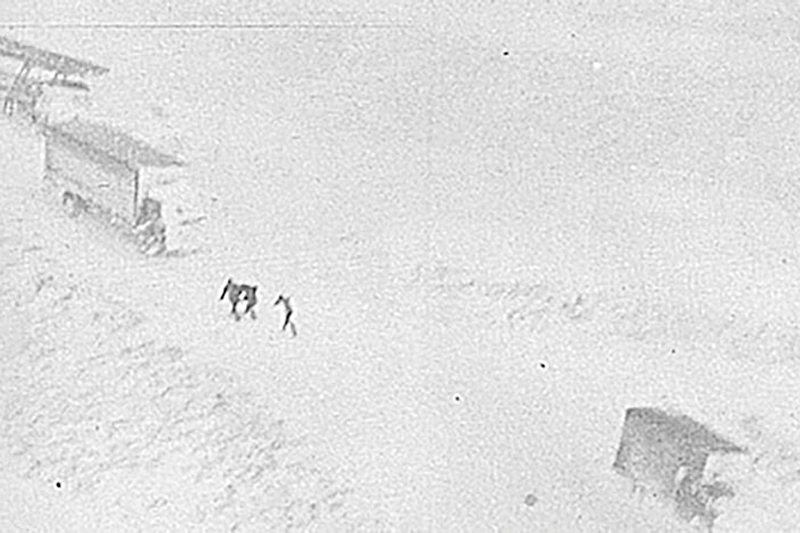
Soon, news was coming in of massive weather problems all over the north. A train going south from Thurso just got lost in the drifts at Forsinard. A very lucky gentleman called Mr. Billy Sutherland left Thurso on Saturday, 28 January to go to Helmsdale with a carload of lady’s underwear. He got stuck at the Ord of Caithness, and his car was buried in fifteen feet of snow. He survived by eating snow, wrapping himself in tights and basically hibernating. He was dug out by police some eighty hours later none the worse for wear. Three people, however, did die in their cars. There was simply no way that any road traffic could reach the outlying places like Rosehall, and the BBC were broadcasting that helicopters would be passing up and down the glens and that if anyone needed supplies, just to make a clear black cross in the snow. Somebody did just that in a house across the Kyle of Sutherland and I remember seeing the chopper dropping down the supplies in the blinding blizzard. Sadly, one of our neighbours had a fall in Altass and had to be helicoptered out to Raigmore Hospital but died shortly thereafter.
During the 1970s we dug over a large vegetable and fruit plot in Rosehall Schoolhouse so we had plentiful supplies of all kinds of vegetables during the Big Snow. However, the garden itself was buried under many feet of snow. I wonder what we did with our deep freeze which was filled with good things like fish and meat. I simply cannot remember. I am sure that we ate as much as we could! But that type of thing was not the concern of a young man. I suppose I should have been doing some studying for my final Sixth Year exams in Golspie High School, but I cannot remember doing any studying.
Right at the end of the week, I remember walking down on the low road by the Kyle and running into Mr. Morrice Mackenzie in his powerful four-wheel drive landrover. He gave me a lift into Altass as he was going to visit Mr. and Mrs. Hugh Mackintosh of Bad Fluich. From then on, traffic started slowly rolling on the roads and school went back on 6 February. However, the snow did not fully thaw as cold snap after cold snap followed. In fact, some of the coldest weather followed the Big Snow. My father attended a funeral in Rosehall Free Church a few Saturdays later when it was so cold that people’s breath was iced inside the church. At that time the Kyle of Sutherland was heavily iced over to a thickness of one or two feet.
We hear much about extreme weather increasing in intensity nowadays, but we should remember that extreme cold weather is becoming rarer and that it is cold, not heat, that kills.
The biggest Search and Rescue Operation in the UK
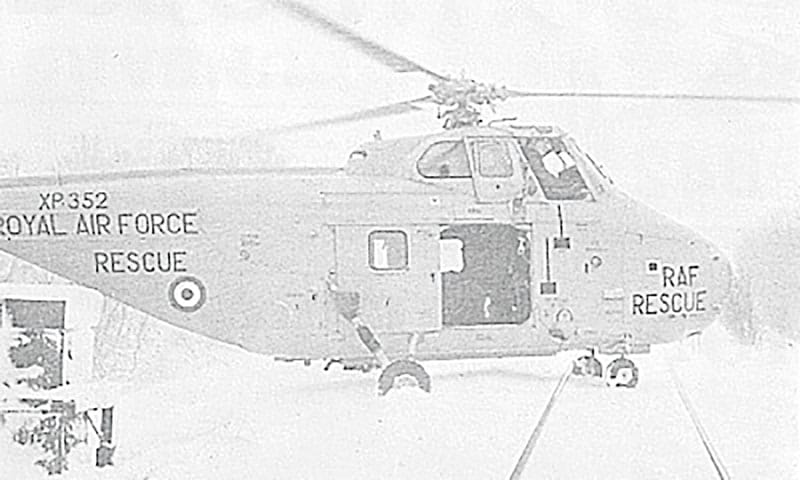
In 2009, Squadron Leader Bill Campbell, AFC, Scottish Saltire Branch, ACA. wrote a poignant account of the storm which can be found on aircrew-saltire.org. He was proud to have played a part in the biggest SAR operation ever mounted in the UK to date (2009). At 7:15 on Sunday morning he was told by Inverness Police that up to 200 people were estimated to be missing in trains, buses and cars.
Unfortunately, the weather conditions were too extreme for helicopter flights, with sky obscured at 200 feet in snow and strong winds. His helicopter finally got airborne at 12:35, tasked to locate vehicles trapped on the A9 north of Helmsdale, Caithness. “One survivor was winched aboard at 13:25 and we landed to pick up another 14 from a post van, articulated lorries, cars, a bus and a snowplough, delivering them in four runs to a car park in Helmsdale.” “Our final survivor from this stretch of road was the driver of an articulated lorry (...) exhausted and confused in the advanced stages of hypothermia.”
In the afternoon they were tasked to locate and evacuate a train with 70 people on board stuck in snow in Forsinard, and a second relief snowplough train with 15 on board. They had no heating since the diesel engine ran out of fuel. With night fast approaching, the helicopters managed to evacuate to Scotscalder all of the passangers at 16:59, 30 minutes after sunset.
From Monday onwards crews were involved in road searches for missing motorists and Aero-Medical Evacuations of sick people and pregnant mums, “including one night pick-up at 19:30 with child born in Raigmore Hospital at 20:30, a close call!” The ‘Operation Whiteout’ as it became known in the RAF resulted in: 372 people evacuated from hostile situations, 85 searches, 390 checks on isolated homes, 215 food deliveries, 12 fuel supply missions, 10 medical supplies drops, 10 priority animal fodder drops, 682 messages logged by the police, 305 hours of helicopter flying (the RAF made it 329) and continuous daylight flying by Shackletons over 3 days.