The Kincardine bell
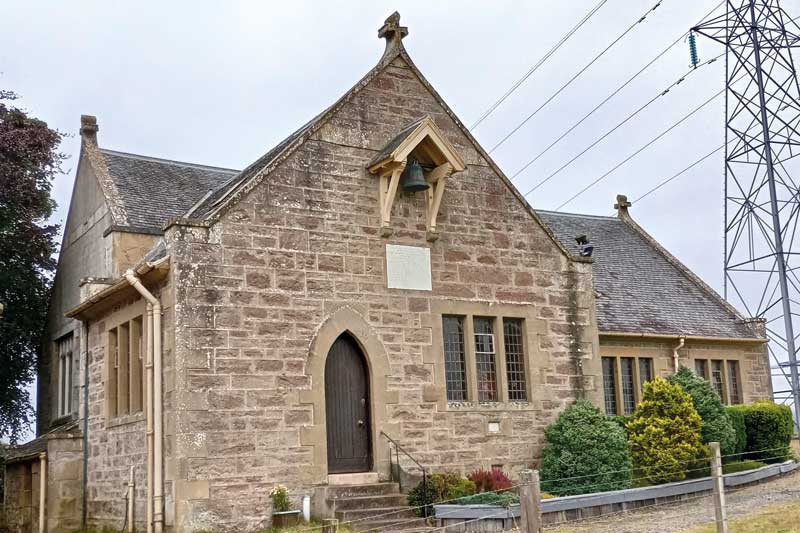
The ship’s bell was donated by Admiral Sir John Lockhart Ross of Balnagown to the Kincardine parish almost 250 years ago. This article is an amplification of the information given about The Kincardine Bell in the Kyle of Sutherland Heritage Society’s book ‘The Kyle of Sutherland a brief history’, based on additional research carried out since its publication.
By Stephen & Rhonwen Copley
The bell first arrived at Kincardine back in 1778 when Mr. Andrew Gallie M.A., minister of the old church, 1774 to 1803, received the gift donated by Admiral Sir John Lockhart Ross Bart. of Balnagown on behalf of the parish.
For a time the bell swung in a tree in the churchyard, but, eventually a bell-arch was built onto on the west gable of the church to give it a more appropriate home.
Meanwhile, Mr. Gallie had composed the text for the inscription reproduced along these lines, which was inscribed on a marble tablet and displayed inside the church.
BELL, CAPTURED IN A FRENCH SHIP OF WAR
OF 74 GUNS WAS GIFTED
BY ADM. SIR JOHN ROSS OF BALNAGOUN, BART.
IN THE YEAR 1778.
TO THE PARISH OF KINCARDINE
When Britains Navies did a World control.
And spread her Empire to the farthest Poles;
High stood our Hero in the Rolls of Fame.
And LOCKHART, then became a Deathlists name
This Bell no more shall witness Blood or Gore.
Nor shall his Voice mix with the Cannons roar.
But to Kincardine by the Hero given.
Shall call the Sinner to the peace of Heaven.
Admiral Sir John Lockhart Ross
John Lockhart was born in November 1721 at Lockhart Hall, Lanarkshire; the fifth son of Sir James Lockhart, 4th Baronet of Carstairs and his wife Grizel, who was the third daughter of William Ross, 12th Lord Ross, and it was through his mother’s line that he would, in 1761, become John Lockhart Ross, 18th Laird of Balnagown.

As a younger son unlikely to inherit anything John started his Royal Navy career in 1735, at the age of 14. He passed his lieutenant’s exam at age 22 and served aboard HMS Devonshire, the flagship of Rear-Admiral Peter Warren, and took part in the First Battle of Cape Finisterre on 3rd. May 1747. In October of the same year, after participating in the Second Battle of Finisterre, he took command of the 64-gun HMS Kent.
With the wars in Europe drawing to a close the demands on the Royal Navy decreased and like many other naval officers, John Lockhart was put on half-pay leave and spent the next few years ashore in Scotland. However, resumption of hostilities with France in 1755 saw him appointed First Lieutenant of the 90-gun HMS Prince and by 1756 he had been promoted to Captain and given command of the 28-gun frigate HMS Tartar.
It was while in command of Tartar that he came to public prominence after his success in capturing several enemy ships including, despite being wounded and invalided ashore for two months earlier in the year, the French 36-gun Melampe in 1757. So high was his reputation that merchants in London and Bristol presented him with ‘pieces of plate’ for his signal service in supporting their trade and the Corporation of Plymouth awarded him the freedom of the borough.
In 1758 he took command of the newly launched 50-gun HMS Chatham and it was in this vessel that he took part in the Battle of Quiberon Bay which was, prior to Trafalgar, the Royal Navy’s most successful engagement against the French. During the battle several French ships were driven aground, amongst them the 74-gun Héros.
On the day after the battle, HMS Chatham was ordered to set fire to the Héros to permanently destroy it, the enemy crew having managed to escape ashore during the night.
While, to date, no definitive proof has been discovered to identify which ship the Kincardine Parish Bell came from, after reviewing his career as far as possible and given that Capt. Lockhart had the rank, reputation and opportunity to acquire the Héros bell, this author feels it is the most likely candidate. The 74-gun Héros had been built in Brest and launched only six years before its final destruction.
Laird of Balnagown
Following the deaths of his elder brothers over the years, in the autumn of 1760 Capt. Lockhart asked to be relieved of his command and that winter, through his mother’s lineage and after adding Ross to his surname, he became Laird of Balnagown.
In 1761, although rejoining HMS Bedford briefly in the summer, he again went onto the half-pay list. This was the same year he became MP for the Linlithgow Boroughs, a seat he held until 1768 when he was elected to the Lanarkshire constituency, which he held until 1774. This must have been a less demanding occupation than naval service as he now found time, at the age of 42, to marry Elizabeth Dundas, in 1763. She was the eldest daughter of the Right Hon. Robert Dundas, the Lord President of the Court of Session in Scotland and the MP for Edinburgh. They went on to produce a family of five sons and three daughters. He also took a keen interest in managing the Balnagown estate, becoming renowned among the local gentry for his new farming practices, as well as championing the upgrading of the local road network to help support local industry.
However, in 1777 with the American War of Independence ongoing and the prospect of France and Spain supporting them, he was back on active duty with the Royal Navy in command of the 74-gun HMS Shrewsbury and took part in the Battle of Ushant in July 1778. The following month he became, through his father’s lineage, the 6th Baronet of Carstairs. 1778 was also the year he donated the bell to Kincardine.
But matters at sea were more pressing as, although still only ranked a Captain, circumstances dictated that he was given command of seventeen ships of the line to patrol the waters off the south of England and down to the Bay of Biscay. It wasn’t until 1779 that he was officially promoted to Rear-Admiral, at the age of 58.

1780 was a lucrative year for the Admiral. January saw him take part in both the capture of the Spanish Convoy and the Moonlight Battle off Cape St. Vincent, after which it was said he was awarded 6,000 guineas as his share of the prizes. The following year he successfully oversaw the landing of stores under heavy fire from onshore Spanish guns during the Second Relief of Gibraltar, after which he returned to patrolling the English Channel.
Unfortunately, it was whilst on patrol in the North Sea in 1782 that his squadron was struck by a flu epidemic. He was so ill he had to strike his flag and go ashore to recover and although he applied to re-join the fleet later that year the Navy declined, as once again peace was on the horizon. But, it did mean he could retire back to Balnagown to continue his recuperation and it was there that he died aged 69, in 1790, his poor health having prevented him taking up any further active naval service. He is buried at Fearn Abbey.
So, Mr. Gallie had it correct - High stood our Hero in the Rolls of Fame – because whatever else Sir John Lockhart Ross did, he certainly hadn’t shrunk from being in harm’s way throughout his naval service and 247 years later our Parish Bell is still here to remind us of that fact.
Today the old Kincardine Parish Church is the Kyle of Sutherland Heritage Centre; the congregation having moved to the newer church building at Lower Gledfield in the mid-1900’s taking the parish bell and its dedication plaque with them.