Wildlife tracking
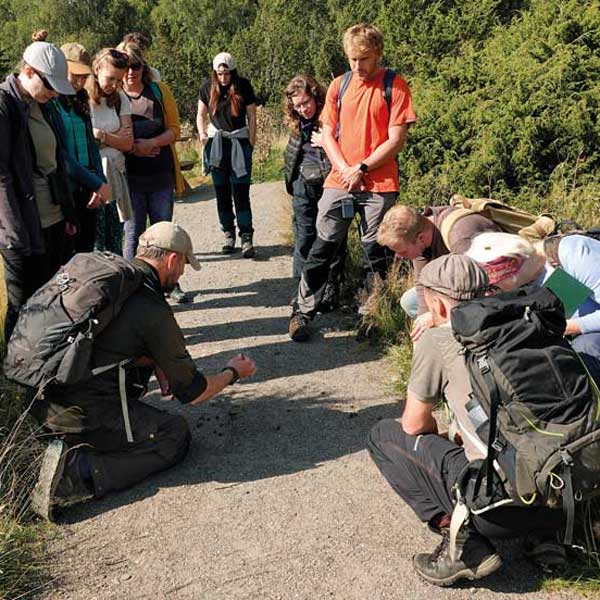
The Dundreggan Rewilding Centre, part of Trees for Life, run a variety of interesting courses throughout the year, but the one that caught my eye was Wildlife Tracking, led by Dan Puplett.
By Cherry Alexander
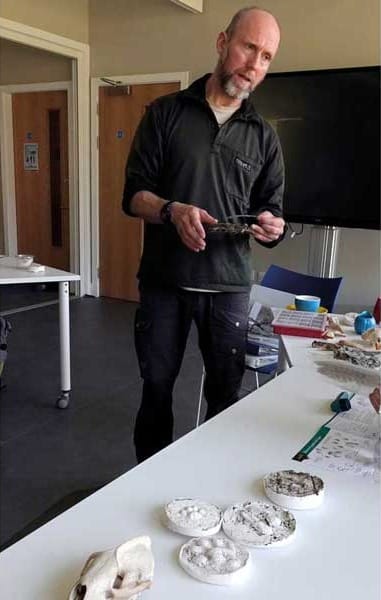
I think I had envisaged us pushing through undergrowth in search of animal tracks and scats (poop). That was certainly part of the day but we started in the classroom, where Dan had a very comprehensive collection of plaster casts of different wildlife feet and skulls, as well as half eaten nuts and cones.
There were 12 of us and I was so pleased to see how well represented the youth element was. We ranged from keen amateurs to people employed by environmental bodies. Dan ran through how tracks vary from those creatures that use the whole of their feet through those doing the equivalent of tiptoe for us and onto the cloven hoofed who are essentially on ballet points. It was useful to see the difference between the kidney shaped palm pads of a badger to the triangular palm of a dog or a fox, but then, magically, foxes have a ridge that runs across their front palm pad, a feature that helps tell them apart from dogs.
Dan asked us to question everything, why and how were results the way they were. In a very short time we went out into the sunshine to see what we could find. Starting with ergot on a head of grass seeds. I had read about these toxic fungal growth on crops eaten by humans but had not thought of them as common, spoiler alert. I did find some in my own garden later.
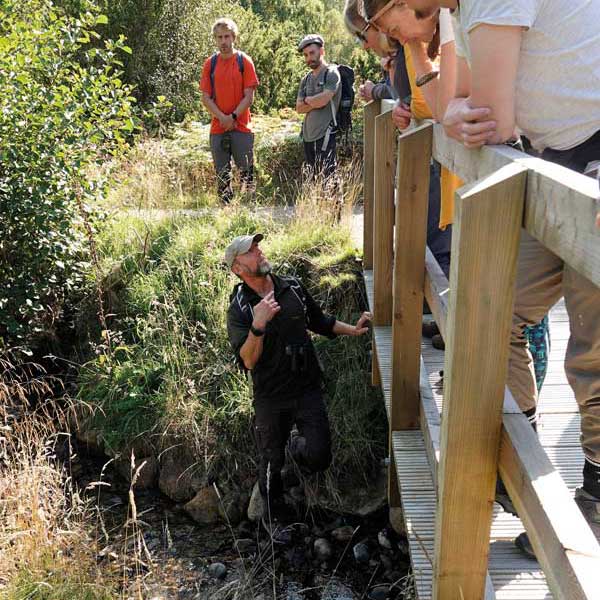
There are lovely walking paths around Dundreggan and I was sceptical that they would yield much in the way of animal tracks as they are hard packed gravel and lots of people were out walking on them that day. But we weren’t just looking for footprints, we listened to the contact calls of goldfinches, which told us they were feeding in a flock close to us, the alarm call of a blackbird who felt we were too close for safety. Constantly Dan asked us to question our surroundings; why was there a hole beside a tree root, someone had spotted the mouse bolting as we approached. Whose poop was it scattered across the path? It turned out it was red deer, they have a small point to each pellet of poop, rather like those Hershey chocolates, and then why was it scattered across the path and not in a pile? It has been running at the time. When we got to the bridge Dan checked under it for signs of otter, but there were none.
We returned to the main building for lunch and then back into the classroom to look at the skulls and ask ourselves and Dan more questions. The beaver skull showed elegantly how they have teeth that keep growing and a skull was handed around, it kept us all guessing as we had to ask one question each, to help identify it. It was a badger skull and I was surprised at how much smaller it was than I had expected. Dan had copious boxes with scats from everything from black grouse to squirrel, we checked them for smell and texture. A valuable aid to knowing what is around you if you can’t see or hear them at the time you pass through.
Scats are a valuable aid to knowing what is around you if you can’t see or hear them
There were more exhibits to demonstrate how a crossbill eats a pine cone differently to a red squirrel, both accessed the pine nuts, but the crossbill split each scale of the cone to get at the seeds it ate. Back out into the woodland and Dan spotted a red deer hoof print, this particular deer had found the path easier to walk on than the undergrowth on either side of the path, and had walked along it for some distance, so we were able to work out from the spacing at what speed it had been travelling. Close to the path there was a bat box up a tree and Dan and a couple of others went up to check if there were any signs around it to indicate it was in use, bat poop caught in cobwebs or in the vegetation. We passed some grazed twigs and Dan explained that they had been grazed by deer because the cut was frayed rather than clean. Tiny signs in the environs that told us more about the big picture. We were asked to consider the needs of all wildlife; they need to find food, shelter and safety.
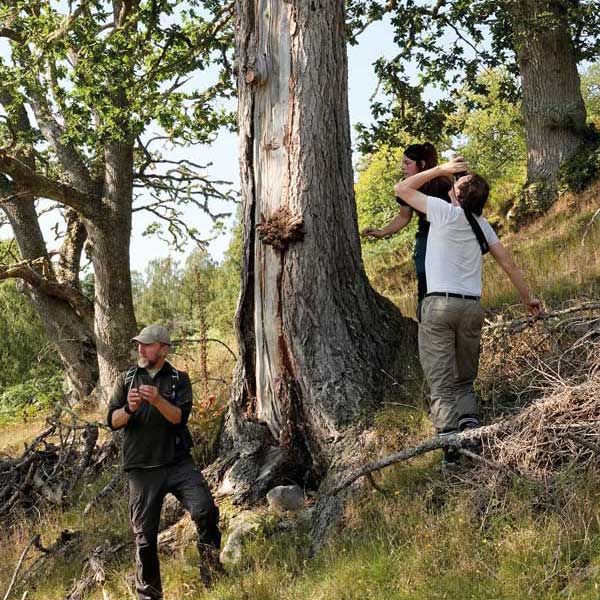
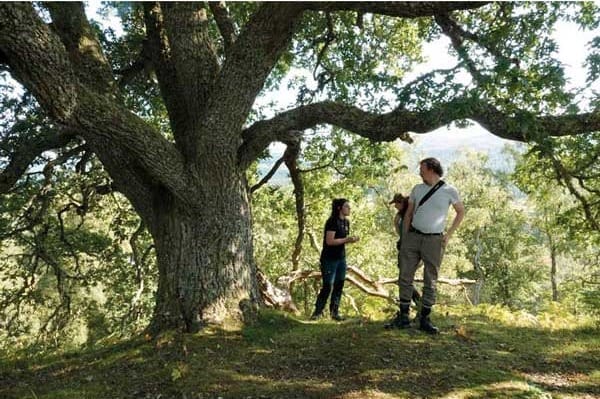
(Left) Looking for bat traces. (Right) The wonderful 400 year old oak. © B&C Alexander / Arcticphoto
Finally we climbed to a small hill, Fairy Hill, on which was a splendid Oak with long branches reaching almost to the ground in places. There were marks on the bark, where the surface had been broken, that indicated recent woodpecker activities. On some fallen branches there were lines of holes with rough edges, more clues that a woodpecker had been at work; the oval holes with crisp edges revealed where longhorn beetles had emerged. Dan explained that the wonderful tree had escaped being felled when all the trees around it had been taken and was probably about 400 years old. The belief was that the hill was home to a group of vengeful fairies so the tree was left alone. As we left the hill, it did cross my mind that if we had a lot more vengeful fairies, our environment might be in a far better state than it is. How do you track a fairy? I wonder if Dan knows. To know more, visit www.danpuplett.net.